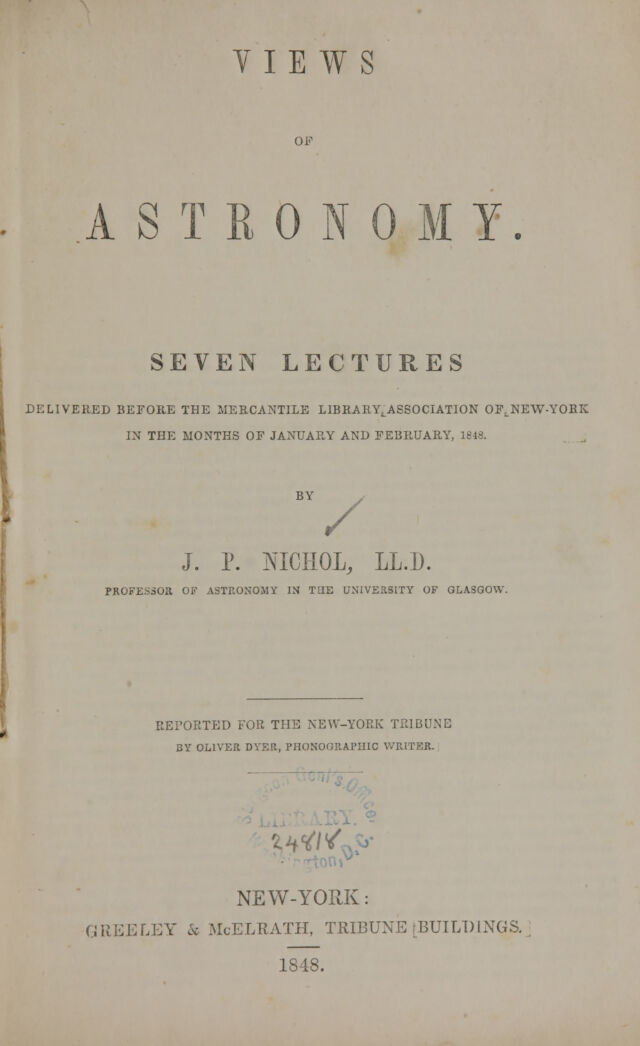
Views of astronomy : seven lectures delivered before the Mercantile Library Association of New York in the months of January and February, 1848 / by J.P. Nichol ; reported for the New-York Tribune by Oliver Dyer.
- John Pringle Nichol
- Date:
- 1848
Licence: Public Domain Mark
Credit: Views of astronomy : seven lectures delivered before the Mercantile Library Association of New York in the months of January and February, 1848 / by J.P. Nichol ; reported for the New-York Tribune by Oliver Dyer. Source: Wellcome Collection.
Provider: This material has been provided by the National Library of Medicine (U.S.), through the Medical Heritage Library. The original may be consulted at the National Library of Medicine (U.S.)
41/52
![I. The play of sudden, tremendous and evanescent forces, either connected 'with the solid body of the Sun or generated within his atmosphere, has be- come an absolute fact; now where and what are these 7 But in the first place, and passing beyond the spots, let us briefly review the whole known phenomena. There appears no rest whatever in the atmos- phere of the Sun. Over all its surface, waves of light seem to dart incessantly, assuming the most varied aspects. The bright part, as Herschel early discerned, is full of inequalities, showing first, parts more brilliant than the rest, sometimes round, sometimes elongated—mountain billows in that light-ocean. Then there are large dim spots ex- tending over immense tracts, but showing no dark center—constituting what Herschel termed shal- lows. We find that these spots are not fixed, but are continually dashing along the center of the Sun. Now, when we come to the consideration of the spots themselves, we find them characterized by certain remarkable phenomena, which will enable us to ascertain their cause. A spot never appears twice in the same place; but although they are not confined to a poiDt, they are confined to regions. They always appears in the Sun's torrid zone. We never find the spot breaking out beyond that belt. Then, again, on looking more minutely, we find the spots themselves have amotion—a motion besides that which the rotation of the Sun causes, and it is most peculiar. We find that the spots which ap- pear North of the Sun's Equator, move slowly toward the North, till they get to the temperate regions, and then disappear. No instance has been known of spots formed in the North going South. Just so, spots of the South move toward the South temperate zone and disappear. There is still another circumstance characterizing the mode in which they disappear. Sometimes they go on till they get to the Sun's temperate re- gions and then quietly die away. At other times, they do not disappear in this manner, but split up just as if they were exploded by some violent force. This phenomenon I had the good fortune once to witness. It is most remarkable. It has been compared to this: Suppose a person stand- ing upon a frozen pond should take up a piece of ice and cast it from him. Now, this mass of ice ■would be broken into a vast number of fragments, which would be scattered over the surface of the pond. This is exactly the manner in which these spots appear to be dashed and scattered over the surface of the Sun. I have now unfolded all the phenomena exhibited by the Solar spots, and we must now direct our endenvors to ascertain their explanation. (Ap- plause.) If, uuappalled by the majesty of the orb on which they proceed, or by the magnitude of the forces causing them, we propose to ourselves under the consciousness of the all-prevalence of Law, to seek out something analogous in cur own planet, we will find them nowhere save among the phenome- na of the winds. But the analogy is everywhere most striking, and probably the most complex and imposing aspects of the surface of the Sun. In ref- erence to the bright pfirt'i which we deem heapiogs up of the shining atmosphere, as well as to the shallows which with the brighter parts are spread over it. our attention is inevitably drawn to the great Barometin chancres that take place on the surface of our globe. You are aware what a change in the Barometer really means. It is this f The Bar- ometer tells you whether the column of air above you is growing lighter or not. If lighter, the Bar- ometer rises—if heavier, it falls. Now, until com- paratively lately, the theory with respect to th© change of weight in the column of air above us, was this : It was attributed to changes in the inte- rior of that column. It was supposed that the air composing it underwent alterations in temperature. But another theory has been propounded, viz. that the changes in the weight of the Column are caused by alterations in its bight, the column not remain- ing at the same elevation, but that it is continually changing—undergoing vast undulations, rolling like mighty billows. Now, you will observe that if we were outside of the earth and the upper portion of our atmosphere were, like the Sun's, self-luminous, then these waves would cause by their various commotions, appearances similar to the spots seen on the surface of the Sun. If we are right, then, the significance of these remarkable phenomena is clear. They indicate the surging of the Solar aerial masses. They are in fact the visible markings of the Solar Barometers; and through these, one day, may come to Science a knowledge of how the winds roll there, and what are their grand periods. This inquiry is the most difficult that the astron- omer has to pursue. We cannot look at the Sun with the naked eye, and the telescope augments bis light. On this account we are compelled, when viewing the Sun, to use dark glasses, which de- tracts very much from the accuracy of our observa- tions. I confess that it has sometimes occurred to me, that we ought, before this, to have got at a means which would enable us to observe the Sun with much greater accuracy than we have hereto- fore been able to do. I refer to the Daguerreotype. You all understand what has been accomplished by this. Now, if by the aid of the Sun, we can produce the most exact likenesses of whatever ob- ject we choose, I do not see why we should not re- quest the Sun to write down his own image. (Ap- plause.) For myself, I cannot see the possibility of failure. It is quite common to mount the teles- cope upon machinery, so as to enable it to follow the movements of the heavens throughout the day. Now, if we could fit up the telescope with these Daguerrean plates and point it at the Sun, we could in one day get a sufficient number of images, that we might take to our closets and examine with our microscopes, to enable us to completely unfold the constitution of the Sun. (Applause.) Let me ascend, however, to what 13 far more striking. I will here remark that I am sure I need not explain to my audience what a boon it was when the hurricanes of the Tropical Regions yield- ed up the secret of their cause. I believe the gen- tleman to whom the world is indebted for this dis- coverv is a resident of this City. His name is — [we did not catch the name]. I see him in the au- dience. (Applause.) These hurricanes are whirl- winds. They do not owe their power to the velo- city with which they are moving over the earth, but to the velocity of their rotation. These hurri- canes, then, are revolving cylinders of air, hollow in the center. Suppose,now, one were outside the atmosphere of the earth aDd looking at one of these phenomena. How would it appear 7 A mere spot, exactly resembling those we observe upon the Sun. Generally, these cylinders are round. In passing over a regular country, they would be round and regular; but if passing over a rough country, bills and mountains, they would be round bat somewhat irregular. Now the spots on the Sun are not exactly round. Therefore, if they are analogous to those of the earth, they show the as- pect of the ground over which they pass. Now, observe the regions in which these hurricanes ap- pear: always in the Tropical Seas. Those occur- ring north of the Equator, move toward the north; while that occurring south of the Equator always](https://iiif.wellcomecollection.org/image/b21143821_0041.jp2/full/800%2C/0/default.jpg)