Creative imagination : studies in the psychology of literature / by June E. Downey.
- June Downey
- Date:
- 1929
Licence: In copyright
Credit: Creative imagination : studies in the psychology of literature / by June E. Downey. Source: Wellcome Collection.
256/264 (page 12)
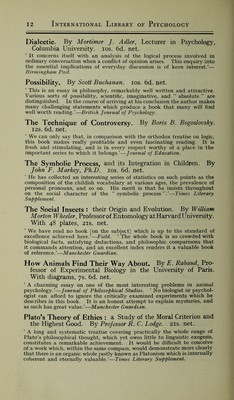
![Dialectic. By Mortimer J. Adler, Lecturer in Psychology, Columbia University, ios. 6d. net. ‘ It concerns itself with an analysis of the logical process involved in ordinary conversation when a conflict of opinion arises. This enquiry into the essential implications of everyday discussion is of keen interest.’— Birmingham Post. Possibility. By Scott Buchanan, ios. 6d. net. ‘ This is an essay in philosophy, remarkably well written and attractive. Various sorts of possibility, scientific, imaginative, and absolute ” are distinguished. In the course of arriving at his conclusion the author makes many challenging statements which produce a book that many will find well worth reading.'—British Journal of Psychology. The Technique of Controversy. By Boris B. Bogoslovsky. 12s. 6d. net. ‘ We can only say that, in comparison with the orthodox treatise on logic, this book makes really profitable and even fascinating reading. It is fresh and stimulating, and is in every respect worthy of a place in the important series to which it belongs.’—Journal of Education. The Symbolic Process, and its Integration in Children. By John F. Markey, Ph.D. ios. 6d. net. ‘ He has collected an interesting series of statistics on such points as the composition of the childish vocabulary at various ages, the prevalence of personal pronouns, and so on. His merit is that he insists throughout on the social character of the “ symbolic process ”.’—Times Literary Supplement. The Social Insects : their Origin and Evolution. By William Morton Wheeler, Professor of Entomology at Harvard University. With 48 plates, 21s. net. ‘ We have read no book [on the subject] which is up to the standard of excellence achieved here.’—Field. ‘ The whole book is so crowded with biological facts, satisfying deductions, and philosophic comparisons that it commands attention, and an excellent index renders it a valuable book of reference.’—Manchester Guardian. How Animals Find Their Way About. By E. Rabaud, Pro¬ fessor of Experimental Biology in the University of Paris. With diagrams, 7s. 6d. net. ‘ A charming essay on one of the most interesting problems in animal psychology.’—Journal of Philosophical Studies. ‘ No biologist or psychol¬ ogist can afford to ignore the critically examined experiments which he describes in this book. It is an honest attempt to explain mysteries, and as such has great value.’—Manchester Guardian. Plato’s Theory of Ethics : a Study of the Moral Criterion and the Highest Good. By Professor R. C. Lodge. 21s. net. ‘ A long and systematic treatise covering practically the whole range of Plato’s philosophical thought, which yet owes little to linguistic exegesis, constitutes a remarkable achievement. It would be difficult to conceive of a work which, within the same compass, would demonstrate more clearly that there is an organic whole justly known as Platonism which is internally coherent and eternally valuable.’—Times Literary Supplement.](https://iiif.wellcomecollection.org/image/b29814662_0256.jp2/full/800%2C/0/default.jpg)