On the therapeutic forces : an effort to consider the action of medicines in the light of the modern doctrine of the conservation of force / by Thomas J. Mays.
- Thomas Jefferson Mays
- Date:
- 1878
Licence: Public Domain Mark
Credit: On the therapeutic forces : an effort to consider the action of medicines in the light of the modern doctrine of the conservation of force / by Thomas J. Mays. Source: Wellcome Collection.
Provider: This material has been provided by the Francis A. Countway Library of Medicine, through the Medical Heritage Library. The original may be consulted at the Francis A. Countway Library of Medicine, Harvard Medical School.
25/152 (page 23)
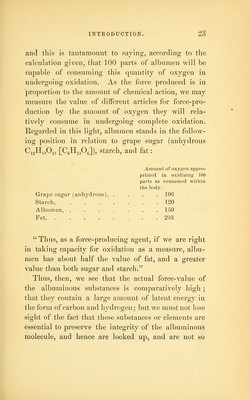
![and this is tantamount to saying, according to the calculation given, that 100 parts of albumen will be capable of consuming this quantity of oxygen in undergoing oxidation. As the force produced is in proportion to the amount of chemical action, we may measure the value of different articles for force-pro- duction by the amount of oxygen they will rela- tively consume in undergoing complete oxidation. Regarded in this light, albumen stands in the follow- ing position in relation to grape sugar (anhydrous CjaHjaO^g [C6Hi20g]), starch, and fat: Amount of oxygen appro- priated in oxidizing 100 parts as consumed witliin the body. Grape sugar (anhj'drous), .... 106 Starch, 120 Albumen, 150 Fat 293 ^•Thus, as a force-producing agent, if we are right in taking capacity for oxidation as a measure, albu- men has about half the value of fat, and a greater value than both sugar and starch.'^ Thus, then, we see that the actual force-value of the albuminous substances is comparatively high ; that they contain a large amount of latent energy in the form of carbon and hydrogen; but we must not lose sight of the fact that these substances or elements are essential to preserve the integrity of the albuminous molecule, and hence are locked up, and are not so](https://iiif.wellcomecollection.org/image/b21066772_0025.jp2/full/800%2C/0/default.jpg)