Meteorological Register for the years 1826, 1827, 1828, 1829, and 1830, from observations made by the surgeons of the army and others at the military posts of the United States / prepared under the direction of T. Lawson ; ato which is appended, the Meteorological register for the years 1822, 1823, 1824, and 1825, compiled under the direction of Joseph Lovell.
- Lawson, Thomas
- Date:
- 1840
Licence: Public Domain Mark
Credit: Meteorological Register for the years 1826, 1827, 1828, 1829, and 1830, from observations made by the surgeons of the army and others at the military posts of the United States / prepared under the direction of T. Lawson ; ato which is appended, the Meteorological register for the years 1822, 1823, 1824, and 1825, compiled under the direction of Joseph Lovell. Source: Wellcome Collection.
Provider: This material has been provided by Royal College of Physicians, London. The original may be consulted at Royal College of Physicians, London.
12/160 page 14
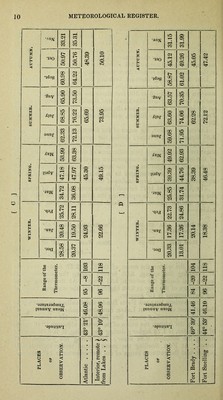
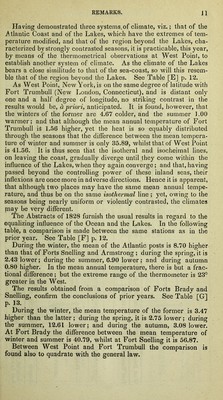
![During the winter, the mean of the latter is 6.46 higher than the former; during the spring, it is 0.08 higher; during the summer, 2.08 lower; and during the autumn, 3.08 higher. At West Point, the range of the mercury is 24° greater than at Fort Trumbull. The Abstracts of 1829 next come under notice. It will be seen that the data of this year lead to the same unvarying conclusions as in all former calculations. See Table [I] p. 15. During the winter, the mean of the E. is 7.55 higher than the W.; during the spring, 5.41 lower; during the summer, 8.38 lower; and during the autumn 0.33 higher. On the ocean the range of the thermometer is 28° less than in the opposite locality. The meteorological report from Fort Brady being imperfect, the usual comparative views are precluded. The establishment of a new post, however, at Houlton, in the interior of Maine, allows a more extended inquiry into the system of climate peculiar to the region lying between the sea-coast and the Lakes. The following posts constitute the points of comparison :— Fort Preble, Maine 43° 38' Hancock Barracks, Me. 46° 10' “ Constitution, N. H. 43° 04' West Point, N. York, 41° 22' Mean lat. 43° 21' Mean lat. 43° 46' —See Table [K] p. 15. During the winter, the mean of the coast is 4.32 higher than the in- terior; during the spring, 1.49 lower; during the summer, 0.90 lower; and during the autumn, 1.73 higher. On comparing the posts sepa- rately, the difference between the summer and winter temperature becomes more apparent. Thus, at Hancock Barracks, it is 47.49, and at Fort Preble 41.66; and at West Point 41.14, and at Fort Constitution 36.55. The extremes of temperature are also indicated by the range of the thermometer; for, whilst the thermometer at Hancock Barracks rises in the summer to 92°, and sinks in the winter 24° below zero, it attains at the Atlantic posts but the same height, and sinks no lower than 6° minus 0. Lastly, the Abstracts of 1830, (which year constitutes the limit of the present investigation,) come under review. On a comparison of the Atlantic region with the interior beyond the Lakes, using the data of the same posts as in the preceding year, no variation is presented in the results. See Table [L] p. 16. During the winter, the mean of the E. is 3.23 higher than the W.; during the spring, 5.60 lower; during the summer, 9.67 lower; and during the autumn, 3.01 lower. At the west, the range of the mercury is 14° greater; and, whilst the difference in the mean temperature of summer and winter is 53° 63', it is but 40.77 on the Atlantic coast. Resuming the comparison between Forts Brady and Snelling, the deductions of former years are confirmed. See Table [M] p. 16.](https://iiif.wellcomecollection.org/image/b28524615_0014.jp2/full/800%2C/0/default.jpg)



 No text description is available for this image
 No text description is available for this image
 No text description is available for this image