Meteorological Register for the years 1826, 1827, 1828, 1829, and 1830, from observations made by the surgeons of the army and others at the military posts of the United States / prepared under the direction of T. Lawson ; ato which is appended, the Meteorological register for the years 1822, 1823, 1824, and 1825, compiled under the direction of Joseph Lovell.
- Lawson, Thomas
- Date:
- 1840
Licence: Public Domain Mark
Credit: Meteorological Register for the years 1826, 1827, 1828, 1829, and 1830, from observations made by the surgeons of the army and others at the military posts of the United States / prepared under the direction of T. Lawson ; ato which is appended, the Meteorological register for the years 1822, 1823, 1824, and 1825, compiled under the direction of Joseph Lovell. Source: Wellcome Collection.
Provider: This material has been provided by Royal College of Physicians, London. The original may be consulted at Royal College of Physicians, London.
17/160 page 19
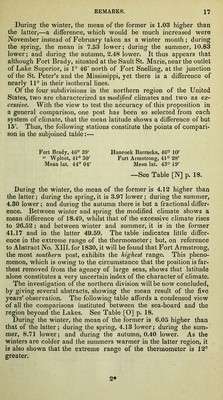
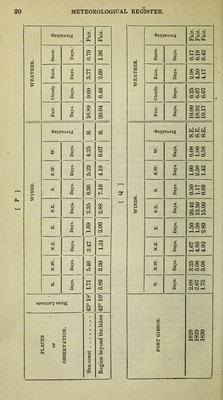
![Deeming it unnecessary to give the course of the winds and other states of the weather for each year, an abstract for the.whole period is now presented.* See Table [P] p. 20. The ratios between the seasons on the Atlantic coast and the in- terior remote from large bodies of water, based on five years’ ob- servation, have been thus reduced to numerical expressions. Although fair weather prevails in both regions, a marked difference obtains in regard to the relative proportion. On the sea-coast, the annual ratio of fair days is 202, and in the opposite locality 240 ; the cloudy days are as 108 to 77 ,* the rainy days are as 45 to 31; and those of snow are as 9 to 16. These ratios, far from being accidental, result from the operation of fixed laws. As the annual quantity of rain depends upon the amount of evaporation, it increases, as a general rule, in proportion as the equator is ap- proached ; and in regard to the seasons, the greatest amount falls when the mean monthly temperature is highest. As this augmented quantity in warm maritime countries falls at a particular season, and in a shorter space of time, than in colder regions, the annual number of dry days, particularly in inland districts, is proportion- ally increased. On the contrary, in the cold or temperate mari- time localities now under consideration, different results follow. Although much less- in annual quantity than in warmer regions, the rain descends much more frequently, but in slighter showers; and hence, a ready explanation is afforded of the fact, that the number of wet and foggy days on the New England coast is one-haff greater than in the dry and cold region beyond the Lakes. Humboldt has given the following table as the proportional quantity of rain in dif- ferent latitudes:— In regard to a particular locality, much will also depend upon the prevailing winds; for it has been observed that the number of days in a year during which the winds blow from a certain point of the compass, at a given place, preserves a constant ratio. This follows from the fact that the force and direction of winds depend on general causes, such as the declination of the sun, the configu- ration'of the coast, and the position of neighbouring continents. This fact is illustrated throughout the Abstracts generally. By way of example, the results of three years’ observation at Fort Gibson, are annexed. See Table [Q] p. 20. * As the proportion of winds and weather, throughout all the Abstracts, is calculated for the average of a month, the result for a year may be readily determined. Eat) 0 19 45 69 Mean annual depth of rain. 96 inches 80 “ 29 “ 17 “](https://iiif.wellcomecollection.org/image/b28524615_0019.jp2/full/800%2C/0/default.jpg)




 No text description is available for this image
 No text description is available for this image
 No text description is available for this image