Meteorological Register for the years 1826, 1827, 1828, 1829, and 1830, from observations made by the surgeons of the army and others at the military posts of the United States / prepared under the direction of T. Lawson ; ato which is appended, the Meteorological register for the years 1822, 1823, 1824, and 1825, compiled under the direction of Joseph Lovell.
- Lawson, Thomas
- Date:
- 1840
Licence: Public Domain Mark
Credit: Meteorological Register for the years 1826, 1827, 1828, 1829, and 1830, from observations made by the surgeons of the army and others at the military posts of the United States / prepared under the direction of T. Lawson ; ato which is appended, the Meteorological register for the years 1822, 1823, 1824, and 1825, compiled under the direction of Joseph Lovell. Source: Wellcome Collection.
Provider: This material has been provided by Royal College of Physicians, London. The original may be consulted at Royal College of Physicians, London.
7/160 page 9
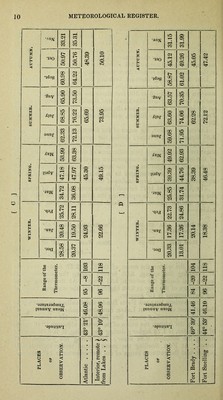
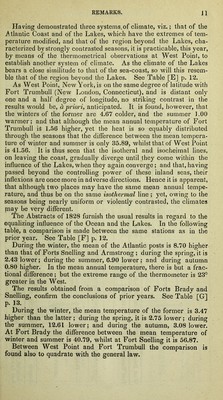
![During the winter, the naean of the east is 8.38 higher than the west ; during the spring, 3.53 lower’, during the summer, 6.99 lower', and during the autumn, 1.54 higher. In the mean tempe- rature for the year there is but a fractional difference. In the extreme range of the thermometer there is a difference of 5°; but an examination of each month shows the range to be much greater at the interior posts remote from the agency of inland seas. Lest this striking contrast between the mean temperature of winter and that of summer might be ascribed to the elevation of the western posts (being 6 or 700 feet above the level of the sea), a com- parison between Forts Mackinac and Snelling, the former situated on the Island of Mackinac, and the latter near the junction of the St. Peters and Mississippi Rivers, will be conclusive upon this point. See Table [B] p. 8. During the winter, the mean of the former, although 1° north, is 3.87 higher than the latter; during the spring, 8.09 lower; during the summer, 8.33 lower; and during the autumn nearly equal. As these two posts present little difference of elevation above the level of the ocean, and are in comparative proximity, the fact—that the winters are less rigorous and the summers more temperate, on the Great Lakes—is demonstrated to be owing, as on the ocean, to the equalizing agency of large bodies of water. The Abstracts of 1827 furnish results corroborative of those of the preceding year. In comparing the Atlantic stations with those in the interior remote from inland seas, the following posts are taken:— Fort Preble, lat. 43° 38' Fort Snelling, lat. 44° 53' „ Constitution „ 43° 04' „ Armstrong „ 41° 28' Mean East 43° 21' Mean West 43° 10' —See Table [C] p. 10. During the winter, the mean of the E. is 2.27 higher than the W.; during the spring, 3.85 lower; during the summer, 8.26 lower; and during the autumn, 1.71 lower. At the W. the mean temperature of the year is 2.88 higher ; and the extreme range of the thermometer is 15° greater. A comparison between Forts Brady and Snelling, in relation to the influence of the Great Lakes, furnishes results confirmatory of those of the preceding year. See Table [D] p. 10. During the winter, the mean of the former, although 1° 46' north of the latter, is 1.76 higher ; during the spring, it is 8.09 lower; during the summer, 9.S4: lower; and during the autumn, 2.37 lower. At Fort Snelling the mean annual temperature is 4.64 higher, and the extreme range of the thermometer is 14° greater.](https://iiif.wellcomecollection.org/image/b28524615_0009.jp2/full/800%2C/0/default.jpg)



 No text description is available for this image
 No text description is available for this image
 No text description is available for this image