Volume 3
Interagency coordination in drug research and regulation : hearings before the Subcommittee on Reorganization and International Organizations of the Committee on Government Operations, United States Senate, Eighty-eighth Congress, first session. Agency coordination study, pursuant to S. Res. 27, 88th Cong. Review of cooperation on drug policies among Food and Drug Administration, National Institutes of Health, Veterans' Administration, and other agencies. Mar. 20-June 26, 1963.
- United States. Congress. Senate. Committee on Government Operations
- Date:
- 1963
Licence: Public Domain Mark
Credit: Interagency coordination in drug research and regulation : hearings before the Subcommittee on Reorganization and International Organizations of the Committee on Government Operations, United States Senate, Eighty-eighth Congress, first session. Agency coordination study, pursuant to S. Res. 27, 88th Cong. Review of cooperation on drug policies among Food and Drug Administration, National Institutes of Health, Veterans' Administration, and other agencies. Mar. 20-June 26, 1963. Source: Wellcome Collection.
307/504 page 1073
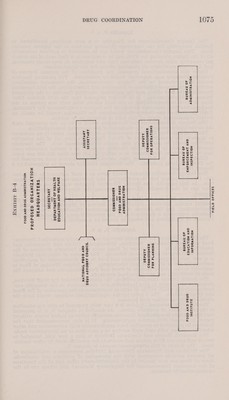
![EXHIBIT 155 CHART BY CHARLES D. May, M.D., ON PROPOSED ORGANIZATION OF SCIENTIFIC PROGRAMS IN THE F'oop AND DRUG ADMINISTRATION The chart referred to by Dr. May in his testimony appears on p. 1074. DIAGRAMMATIC REPRESENTATION OF MAJOR ELEMENTS OF ORGANIZATION OF F'oop AND DRruG ADMINISTRATION To FACILITATE DEVELOPMENT AND INTEGRATION OF SCIENTIFIC PROGRAM (Prepared by Charles D. May, M.D., Mar. 14, 1963) TO BE COMPARED WITH EXHIBITS B—4, B—5 IN “APPENDIX OF REPORT ON FDA BY CITIZENS ADVISORY COMMITTEE,” OCTOBER 1962 Hssential feature is to have chief scientist on par with heads of other major divisions, and with direct and methodical access to the Commissioner. Like- wise directors of scientific bureaus are on a par and each has direct access to Associate Commissioner for Science and direct access to each other. [Exhibits B4 and B—-5 appear in Exhibit 156 below. ] ExuHIsit 156 EXCERPTS FROM REPORT BY THE SECOND CITIZENS ADVISORY COMMITTEE ON THE Foop AND DruG ADMINISTRATION WITH REGARD TO PROPOSED REORGANIZATION OF SCIENTIFIC PROGRAMS There follow excerpts from the report of October 1962 by the Second Citizens Advisory Committee on the Food and Drug Administration. These excerpts relate to the proposed reorganization of scientific programs as commented upon by Dr. May. Excerpts From Report By SECOND CITIZENS ADVISORY COMMITTEE ON FOOD AND Drug ADMINISTRATION Appendix B, p. 4 DETAILS OF RECOMMENDED ORGANIZATION PLAN The details of the plan of organization which the committee believes would equip FDA to fulfill the responsibilities recommended in this report are pre- sented below. The overall plan of organization appears in exhibit B-4, on the following page. It incorporates a number of basic changes from the present plan. At the ' top policy level, an Assistant Secretary of HEW is proposed as a staff aid to the Secretary, with fulltime responsibilities for keeping informed of FDA and PHS activities, and for providing a more effective channel of communications between _the Secretary and the Commissioner. This Assistant Secretary would have no line operating authority over FDA; rather, he would be the Secretary’s specialist for this agency and for PHS, and would aid in channeling the Secretary’s attention to major FDA and PHS problems and relationships, to ensure consist- ent policy application. He also would be the staff aid for promoting coordina- tion of functions between FDA and PHS to the extent desirable. Under the Commissioner of FDA, there would be 2 main staff units and 4 main operating units at the headquarters level, as follows: Staff Headquarters Activities Deputy Commissioner for Planning Deputy Commissioner for Operations Line Headquarters Operations Food and Drug Institute Bureau of Education and Information Bureau of Enforcement and Inspection Bureau of Administration The major duties and the organizational details of each of these units are described below, together with the basic changes these would represent. 88-311—638—-pt. 320](https://iiif.wellcomecollection.org/image/b32183148_0003_0307.jp2/full/800%2C/0/default.jpg)