Principles of human physiology / by William B. Carpenter ; edited by Henry Power.
- Date:
- 1864
Licence: Public Domain Mark
Credit: Principles of human physiology / by William B. Carpenter ; edited by Henry Power. Source: Wellcome Collection.
Provider: This material has been provided by the Royal College of Physicians of Edinburgh. The original may be consulted at the Royal College of Physicians of Edinburgh.
25/988
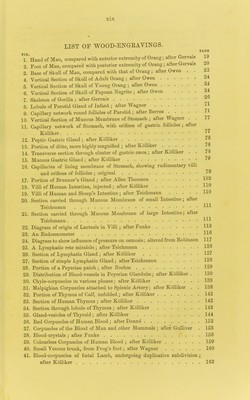
![TABLE OF ILL US TEAT IONS. PLATE I. FIO. 1. Spermatozoa of Man ; A, viewed on the surface ; B, viewed edgeways (§ 720). 2. Vesicles of evolution from the seminal fluid of the Dog; A, B, C, single vesicles of different sizes; D, single vesicle within its parent-cell; E, parent-cell enclosing seven vesicles of evolution (§ 721). 3. Development of Spermatozoa within the vesicles of evolution; A, B, vesicles containing spermatozoa in process of formation; c, D, spermatozoa escaping from the vesicles (§ 721). [The three preceding figures are after Wagner and Leuckardt ( Cyclop, of Anatomy and Physiology, Art. 'Semen').] 4. Thin slice of the ovarium of a Sow three weeks old, showing the Graafian vesicles or ovisacs imbedded in a fibro-cellular stroma. The ovisacs are filled with cells, in the midst of which one large one may be specially distinguished ; this, which is the germinal vesicle, is surrounded by minute granules, which constitute the first indication of the yolk (§ 728). 5. Ovum of a Rabbit, showing the vitelline mass almost entirely converted into distinct cells, of which those at the surface are pressed against each other and against the zona pellucida, so as to assume a hexagonal form. The dark portion consists of a mass of vitelline spheres, which has not under- gone this conversion (§ 766). 6. Ovum of the Rabbit, seven days after impregnation, viewed on a black ground. The outer membrane is the chorion, on which are seen incipient villosities. Within this is the blastodermic vesicle, at the summit of which is the projection formed by the area germinaliva; and from this, the mucous layer of the germinal membrane is seen to extend over about one-third of the surface of the contained yolk (§ 766). 7. Portion of the germinal membrane, taken from the area yerminativa, to show the two layers of which it is composed; the serous, or animal layer, is turned back, so as to show the mucous or vegetative layer in sdu. In the latter is seen the primitive trace (§ 766). 8. Portion of the serous layer of the germinal membrane, highly magnified; showing that it is made-up of nucleated cells, united by intercellular substance, and filled with minute molecules (§ 766).](https://iiif.wellcomecollection.org/image/b21965249_0025.jp2/full/800%2C/0/default.jpg)