Modern surgery : General and operative / by John Chalmers Da Costa.
- John Chalmers DaCosta
- Date:
- 1900
Licence: Public Domain Mark
Credit: Modern surgery : General and operative / by John Chalmers Da Costa. Source: Wellcome Collection.
Provider: This material has been provided by the Augustus C. Long Health Sciences Library at Columbia University and Columbia University Libraries/Information Services, through the Medical Heritage Library. The original may be consulted at the the Augustus C. Long Health Sciences Library at Columbia University and Columbia University.
983/1170 (page 965)
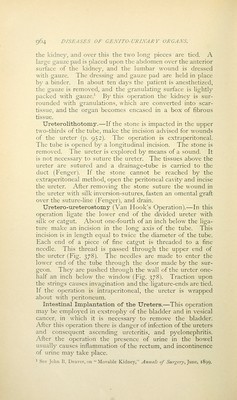
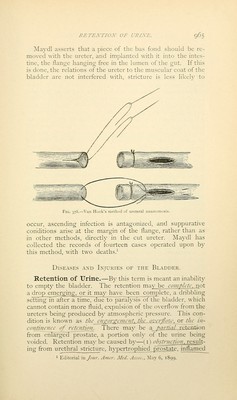
![]\Ia}dl asserts that a piece of the bas fond should be re- moved with the ureter, and implanted with it into the intes- tine, the flange hanging free in the lumen of the gut. If this is done, the relations of the ureter to the muscular coat of the bladder are not interfered with, stricture is less likeh- to Fig. 37S.—Van Hook's method of ureteral anastomosis. occur, ascending infection is antagonized, and suppurative conditions arise at the margin of the flange, rather than as in other methods, directly in the cut ureter. ]Maydl has collected the records of fourteen cases operated upon b}- this method, with two deaths.^ Diseases and In'juries of the Bladder. Retention of Urine.—By this term is meant an inabilit}- to empt}- the bladder. The retention mav be complete, v^ot a drop emerging, or it may have been complete, a dribbling seTting in after a time, due to paralysis of the bladder, which cannot contain more fluid, expulsion of the overflow from the ureters being produced by atmospheric pressure. This con- dition is known as thc_cngorgciiic]it. the ovcrjloic, or the iii- coiitiTicnce of reteiition. There ma\' be a_/rt^;::^/<iZ_xeteution from enFarge^ prostate, a portion only of the urine being voided. Retention may be caused by—(i) obstriiction. result- ing from urethral stricture, hypertrophied prostate, inflamed](https://iiif.wellcomecollection.org/image/b21224870_0983.jp2/full/800%2C/0/default.jpg)