Tissue banks : the dangers of tainted tissues and the need for federal regulation : hearing before the Committee on Governmental Affairs, United States Senate, One Hundred Eighth Congress, first session, May 14, 2003.
- United States. Congress. Senate. Committee on Governmental Affairs
- Date:
- 2003
Licence: Public Domain Mark
Credit: Tissue banks : the dangers of tainted tissues and the need for federal regulation : hearing before the Committee on Governmental Affairs, United States Senate, One Hundred Eighth Congress, first session, May 14, 2003. Source: Wellcome Collection.
102/126 page 98
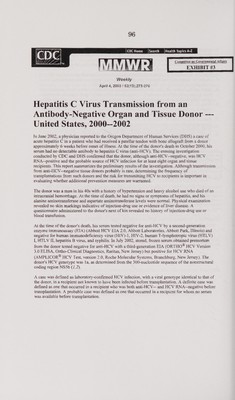
![antibody-negative, HCV RNA--positive organ and tissue donors is not known. However, among voluntary blood donors, whose characteristics probably differ from those of organ and tissue donors, approximately four per 1,000,000 blood donations are from donors who are anti- HC V--negative and HCV RNA--positive (8). Donor screening is the primary means of preventing transmission of viral infections from organs and tissues. The Food and Drug Administration (FDA) and the Health Resources and Services Administration (HRSA) provide regulatory guidance or oversight for screening of tissue and organ donors. In addition, organ procurement organizations are required by the Centers for Medicare & Medicaid Services to ensure that appropriate donor screening tests are performed by a laboratory certified in accordance with the Clinical Laboratory Improvement Amendments of 1988. The donor screening process includes medical chart review, interview of the donor's next of kin, physical assessment, and testing of donor serum. Guidelines require that organ and tissue donors be tested for anti-HCV. Nucleic acid testing (NAT) to detect HCY RNA among organ and tissue donors is not performed routinely and has severa! limitations. Organ viability declines rapidly as a function of time after donor death. Because NAT often is not immediately accessible and can require ]1--2 days to complete, it might be impractical in the setting of organ transplantation. By contrast, tissues often can be stored for months to years before use, allowing ample time for NAT. However, postmortem serum frequently is the only sample available for testing from tissue donors. NAT to detect HCV RNA has not been approved by FDA for use on serum samples obtained postmortem, and the performance of available assays in this setting has not been evaluated. Tissue processing methods (e.g., gamma irradiation) might affect the likelihood of transmission of HCV and other viruses from infected donors (3,9). In this investigation, no cases occurred in recipients of irradiated bone. Irradiation is not applied routinely to all tissue types because it can impair tissue structural integrity. This investigation was initiated by a clinician who suspected allograft-associated HCV transmission and alerted the state health department. When a new case of hepatitis C is diagnosed in a recent tissue or organ recipient, health-care providers should notify local or state health departments promptly so an investigation can be initiated and, if necessary, tissues can be recalled to prevent further transmission. Centers performing transplantation should maintain adequate records of graft recipients to facilitate investigations of allograft-associated infections. CDC, in collaboration with FDA and IIRSA, will determine whether changes in organ and tissue donor screening guidelines are warranted. Assessing the performance of available NAT and anti- HCV assays in postmortem specimens would provide essential information about the period during which donor screening can be performed reliably. Although transmission from anti-HCV--negative tissue donors probably is rare, determining the frequency of transplantations from such donors and the risk for transmitting HCV to recipients will be uscful for evaluating the benefits and limitations of additional prevention measures. Acknowledgments This report is based on information contributed by H Homan, Multnomah County Health Dept; DN Gilbert, MD, Providence Portland Medical Center and Oregon Health and Science Univ; C Corless, MD, Oregon Health and Science Univ; S Kemeny, MD, Providence Portland Medical Center, Portland, Oregon. M Kainer, MD, Tennessee Dept of Health. W Kuhnert, PhD, Div of Viral](https://iiif.wellcomecollection.org/image/b32221514_0102.jp2/full/800%2C/0/default.jpg)