Tissue banks : the dangers of tainted tissues and the need for federal regulation : hearing before the Committee on Governmental Affairs, United States Senate, One Hundred Eighth Congress, first session, May 14, 2003.
- United States. Congress. Senate. Committee on Governmental Affairs
- Date:
- 2003
Licence: Public Domain Mark
Credit: Tissue banks : the dangers of tainted tissues and the need for federal regulation : hearing before the Committee on Governmental Affairs, United States Senate, One Hundred Eighth Congress, first session, May 14, 2003. Source: Wellcome Collection.
111/126 page 107
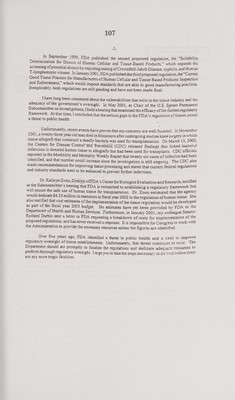
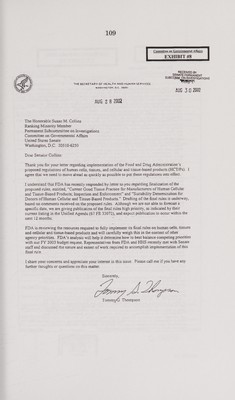
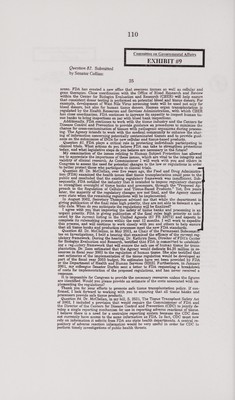
![Be In September 1999, FDA published the second proposed regulation, the “Suitabiltty Determination for Donors of Human Celular and Tissue-Based Products,” which expands the screening of potential donors by requiring testing of Creutzfeld-Jakob Disease, syphilis, and Human T-lymphotropic viruses. InJ anuary 2001, FDA published the third proposed regulation, the “Current Good Tissue Practice for Manufacturers of Human Cellular and Tissue Based Products: Inspection and Enforcement,” which would impose standards that are akin to good manufacturing practices. Inexplicably, both regulations are stil] pending and have not been made final. Thave long been concemed about the vulnerabilities that exist in the tissue industry and the adequacy of:the government’s Oversight. In May 2001, as Chair of the U.S. Senate Permanent Subcommittee on Investigations, [held a hearing that examined the efficacy of the current regulatory framework. At that time, I concluded that the serious gaps in the FDA’s regulation of tissues posed a threat to public health. Unfortunately, recent events have proven that my concerns are well founded. In November 2001, a twenty-three year old man died in Minnesota after undergoing routine knee surgery in which tissue allograft that contained a deadly bacteria was used for transplantation. On March 15, 2002, the Centers for Disease Control-and Prévention (CDC) released findings that linked bacterial infecuons in donated human tissue to allografts that had been used for transplants. CDC officials reported in the Morbidity and Mortality Weekly Report that twenty six cases of infection had been identified, and that number could increase since the investigation is still ongoing. The CDC also made recommendations for improving tissue processing and stated that current federal regulations and industry standards need to be enhanced to prevent further infections. Dr. Kathryn Zoon, Director of FDA’s Center for Biologics Evaluation and Research, testified at the Subcommittee’s hearing that FDA is committed to establishing a regulatory framework that will ensure the safe use of human tissue for transplantation. Dr. Zoon estimated that the agency would dedicate $4.35 million in resources in fiscal year 2002 to the regulation of human tissue. She also testified that cost estimates of the implementation of the tissue regulation would be developed as part of the fiscal year 2003 budget. No estimates have yet been provided by FDA or the Department of Health and Human Services. F urthermore, in January 2001, my colleague Senator Richard Durbin sent a letter to FDA requesting a breakdown of costs for implementation of the proposed regulations, and has never received a response. It is impossible for Congress to work with the Administration to provide the necessary resources unless the figures are identified. Over five years ago, FDA identified a threat to public health and a need to improve regulatory oversight of tissue establishments. Unfortunately, that threat continuss to exist. The Department should act promptly to finalize the regulations and dedicate adequaze resources 60 perform thorough regulatory oversight. urge you to take the steps necessary to Co 7014 oefore there are any more tragic fatalities.](https://iiif.wellcomecollection.org/image/b32221514_0111.jp2/full/800%2C/0/default.jpg)