Tissue banks : the dangers of tainted tissues and the need for federal regulation : hearing before the Committee on Governmental Affairs, United States Senate, One Hundred Eighth Congress, first session, May 14, 2003.
- United States. Congress. Senate. Committee on Governmental Affairs
- Date:
- 2003
Licence: Public Domain Mark
Credit: Tissue banks : the dangers of tainted tissues and the need for federal regulation : hearing before the Committee on Governmental Affairs, United States Senate, One Hundred Eighth Congress, first session, May 14, 2003. Source: Wellcome Collection.
96/126 page 92
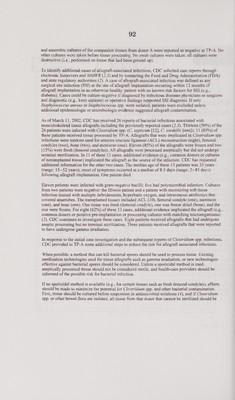
![and anacrobic cultures of the companion tissues from donor A were reported as negative at TP-A. No other cultures were taken before tissue processing. No swab cultures were taken; all cultures were destructive (i.e., performed on tissue that had been ground up). To identify additional cases of allograft-associated infections, CDC solicited case reports through electronic listservers and MMWR (2,3) and by contacting the Food and Drug Administration (FDA) and state regulatory authorities (2). A case of allograft-associated infection was defined as any surgical site infection (SSI) at the site of allograft implantation occurring within 12 months of allograft implantation in an otherwise healthy patient with no known risk factors for SSI (e.g., diabetes). Cases could be culture-negative if diagnosed by infectious diseases physicians or surgeons and diagnostic (e.g., knee aspirate) or operative findings supported SSI diagnosis. If only Staphylococcus aureus or Staphylococcus spp. were isolated, patients were excluded unless additional epidemiologic or microbiologic evidence suggested allograft contamination. As of March 11, 2002, CDC has received 26 reports of bacterial infections associated with musculoskeletal tissue allografts including the previously reported cases (2, 3). Thirteen (50%) of the 26 patients were infected with Clostridium spp. (C. septicum [12], C. sordellii [one]); 11 (85%) of these patients received tissue processed by TP-A. Allografts that were implicated in Clostridium spp. infections were tendons used for anterior cruciate ligament (ACL) reconstruction (eight), femoral condyles (two), bone (two), and meniscus (one). Eleven (85%) of the allografts were frozen and two (15%) were fresh (femoral condyles). All allografts were processed aseptically but did not undergo terminal sterilization. In 11 of these 13 cases. additional evidence (e.g., common donors or cultures of nonimplanted tissue) implicated the allograft as the source of the infection. CDC has requested additional information for the other two cases. The median age of these 13 patients was 35 years (range: 15--52 years); onset of symptoms occurred at a median of 8.5 days (range: 2--85 days) following allograft implantation. One patient died. Eleven patients were infected with gram-negative bacilli; five had polymicrobial infection. Cultures from two patients were negative: the IIinois patient and a patient with necrotizing soft tissue infection treated with multiple debridements, hyperbaric oxygen, and intravenous antibiotics that covered anaerobes. The transplanted tissues included ACL (/0), femoral condyle (one), meniscus (one), and bone (one). One tissue was fresh (femoral condyle), one was freeze dried (bone), and the rest were frozen. For eight (62%) of these 13 cases, additional evidence implicated the allograft (e.g., common donors or positive pre-implantation or processing cultures with matching microorganisms) (2). CDC continues to investigate these cases. Eight patients received allografts that had undergone aseptic processing but no terminal sterilization. Three patients received allografts that were reported to have undergone gamma irradiation. In response to the initial case investigation and the subsequent reports of Clostridium spp. infections, CDC provided to TP-A some additional steps to reduce the risk for allograft associated infections. When possible, a method that can kill bacterial spores should be used to process tissue. Existing sterilization technologies uscd for tissue allografts such as gamma irradiation, or new technologics effective against bacterial spores should be considered. Unless a sporicidal method is used, aseptically processed tissue should not be considered sterile, and health-care providers should be informed of the possible risk for bacterial infection. If no sporicidal method is available (e.g., for certain tissues such as fresh femoral condyles), efforts should be made to minimize the potential for Clostridium spp. and other bacterial contamination. First, tissue should be cultured before suspension in antimicrobial solutions (4), and if Clostridium spp. or other bowel flora are isolated, all tissue from that donor that cannot be sterilized should be](https://iiif.wellcomecollection.org/image/b32221514_0096.jp2/full/800%2C/0/default.jpg)