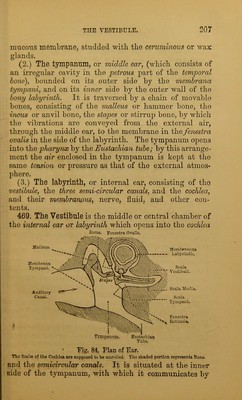
Elements of animal physiology, chiefly human : with hints on practical work, dissection, &c / by John Angell.
- Angell, John
- Date:
- 1875
Licence: Public Domain Mark
Credit: Elements of animal physiology, chiefly human : with hints on practical work, dissection, &c / by John Angell. Source: Wellcome Collection.
216/264
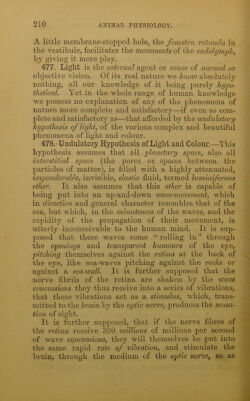
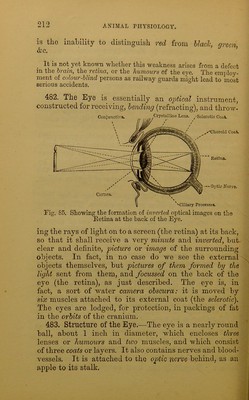
![is the inability to distinguish red from black, green &c. It is not yet known whether this weakness arises from a defect in the brain, the retina, or the humours of the eye. The employ- ment of colour-blind persons as railway guards might lead to most serious accidents. 482. The Eye is essentially an optical instrument, constructed for receiving, bending (refracting), and throw- PAnin.inti.a Orystiil]me Lciis. Sclerotic Coul. 'Choroid Coal. Retina. — Ontie Nerve. ''Ciliary Processes. Fig. S5. Showing the formation of inverted optical images on the Retina at the back of the Eye. ing the rays of light on to a screen (the retina) at its back, so that it shall receive a very minute and inverted, but- clear and definite, picture or image of the surrounding objects. In fact, in no case do we see the external objects themselves, but pictures of them formed by the light sent from them, and focussed on the back of the eyo (the retina), as just described. The eye is, in fact, a sort of water camera obscura: it is moved by six muscles attached to its external coat (the sclerotic). The eyes are lodged, for protection, in packings of fat in the orbits of the cranium. 483. Structure of the Eye.—The eye is a nearly round ball, about 1 inch in diameter, which encloses three lenses or humours and two muscles, and which consist of three coats or layers. It also contains nerves and blood- vessels. It is attached to the optic nerve behind, as an apple to its stalk.](https://iiif.wellcomecollection.org/image/b28056577_0216.jp2/full/800%2C/0/default.jpg)