Experimental study of children : including anthropometrical and psycho-physical measurements of Washington school children, and a bibliography / by Arthur MacDonald.
- MacDonald, Arthur, 1856-1936.
- Date:
- 1899
Licence: Public Domain Mark
Credit: Experimental study of children : including anthropometrical and psycho-physical measurements of Washington school children, and a bibliography / by Arthur MacDonald. Source: Wellcome Collection.
29/338 (page 1007)
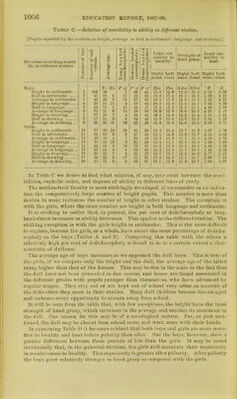
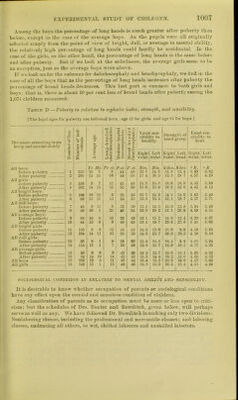
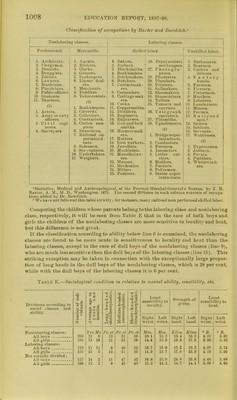
![Among the boys Hie percentage of long heads is much greater after puberty than before, except in the case of tiro average boys. As the pupils were all originally selected simply from the point of view of bright, dull, or average in mental ability, the relatively high percentage of long heads could hardly bo accidental. In tho case of tho girls, on the other hand, the percentage of long heads is the same beforo and after pubeity. But if we look at the subclasses, the average girls seem to be an exception, just as tho average boys were above. If we look under tho columns for dolichoeephaly and brachycephaly, we lind in tho case of all the boys that as the percentage of long heads increases after puberty the percentage of broad beads decreases. This last part is common to both girls and boys; that is, there is about 10 per cent less of broad beads after puberty among the 1,074 children measured. Taw rc D —Puberty in relation lo cephalic index, strength, and sensibility. [The legal ages for puberty are followed boro, age 12 for girls, and age It for boys ] Divisions according to pu berty and mental ability 6 o G c* O “ f- ~ o *3 <c to « bo 0) ci -G dj G< Z. « o ija a ^ -3 ■ ® O gj if o S 'w *c3 a g: Qj ft z. © •a « Least sen- sibility to locality. Stren band 2th of grasp. Least sen- sibility lo beat. 3 'A 3 23 'A h 9 — r. 73 Z) 9 G is CQ£. Bight wrist. Left wrist Bight band. Left band. Bight wrist. Left. wrist. All boys; Beforo puberty i 315 Yr Mo. 10 7 Pr c t. 8 Pci. 44 P ct 48 Mm. 15.7 Mm 14. 9 Kilos. 14. 0 Kilos. 13.4 ° It. 3.89 ° R. 3. 62 After puberty 2 201 15 11 16 48 36 17 4 16 5 31. 3 28 7 4.57 4.20 Ail girls; Before puberty 3 186 9 7 11 41 48 14. 5 13.8 10.6 10.0 4. 35 3. 89 -1 362 14 11 11 51 38 15 0 13 8 10 8 18. 0 4. 45 4. 13 All bright boys; Before pubeity 5 168 10 11 0 51 43 15 7 14. 8 14 3 13.6 3 65 3. 40 A fter puberty G 69 15 11 13 54 33 16.8 15.4 33.1 29.7 4.17 3.71 Ail dull boys; Bolbro puberty 7 49 9 11 6 35 59 15.1 14 5 13.0 12.8 3. 94 3. 46 Alter puberty 8 88 10 1 21 45 34 16 9 16 2 31-1 28. 8 4.59 4.34 All average boys: Before puberty 9 98 10 6 13 38 49 10 1 15 2 14 0 13.4 4.28 4.07 After puberty 10 44 15 8 9 48 43 19. 4 18 7 29. 0 27.0 5 15 4.66 All bright girls: Before puberty 11 105 9 8 12 45 43 14.3 13.6 10.6 9.9 4. 19 3.68 Al'terpuberty 12 164 14 11 12 55 33 14.6 13 7 20. S 19.3 4 16 3. S9 All dull girls: Before puberty 13 35 9 1 9 28 63 15.4 14.4 10.4 9 9 4.61 3.94 After puberty 14 114 15 1 7 53 40 15.0 13 7 18.9 18.2 4. 77 4. 33 All average girls: Before puberty 15 40 9 9 9 43 48 14 4 13.7 10.6 10.1 4. 95 4.32 After puberty 16 84 14 10 14 45 41 15. 5 14.4 19.2 18.0 4.58 4.32 All boys 17 526 12 0 11 i 45 44 16.4 15.5 20.9 19.6 4. 17 3.89 All girls 18 548 13 1 12 48 40 14.9 13.9 16.8 15.8 4.43 4. 06 SOCIOLOGICAL CONDITION IN DELATION TO MENTAL ABILITY AND SENSIBILITY. It is desirable to know whether occupation of parents or sociological conditions have any effect upon the mental and sensitive condition of children. Any classification of parents as to occupation must be more or less open to criti- cism j but the schedules of Drs. Baxter and Bowditch, given below, will perhaps serve as well as any. We have followed Dr. Bowditch in making only two divisions: Noniaboring classes, including the professional and mercantile classes; and laboring classes, embracing all others, to wit, skilled laborers and unskilled laborers.](https://iiif.wellcomecollection.org/image/b2811663x_0029.jp2/full/800%2C/0/default.jpg)