A dictionary of practical medicine: comprising general pathology, the nature and treatment of diseases, morbid structures, and the disorders especially incidental to climates, to the sex, and to the different forms of life : with numerous prescriptions for the medicines recommended, a classification of diseases according to pathological principles, a copious bibliography, with references, and an appendix of approved formulae : the whole forming a library of pathology and practical medicine and a digest of medical literature (Volume 9).
- James Copland
- Date:
- 1834-59
Licence: Public Domain Mark
Credit: A dictionary of practical medicine: comprising general pathology, the nature and treatment of diseases, morbid structures, and the disorders especially incidental to climates, to the sex, and to the different forms of life : with numerous prescriptions for the medicines recommended, a classification of diseases according to pathological principles, a copious bibliography, with references, and an appendix of approved formulae : the whole forming a library of pathology and practical medicine and a digest of medical literature (Volume 9). Source: Wellcome Collection.
Provider: This material has been provided by the National Library of Medicine (U.S.), through the Medical Heritage Library. The original may be consulted at the National Library of Medicine (U.S.)
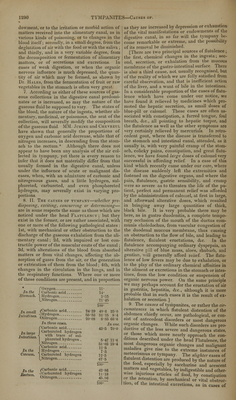
![dowment, or to the irritation or morbid action of matters received into the alimentary canal, as in various kinds of poisoning, or to changes in the blood itself; secondly, in a small degree, from the deglutition of air with the food or with the saliva ; and thirdly, and in a very variable degree, from the decomposition or fermentation of alimentary matters, or of secretions and excretions. In cases of weak digestion, or when the organic nervous influence is much depressed, the quan- tity of air which may be formed, as shown by Dr. Hales, from the fermentation of fruit or raw vegetables in the stomach is often very great. 7. According as either of these sources of gas- eous collections in the digestive canal predomi- nates or is increased, so may the nature of the gaseous fluid be supposed to vary. The states of the blood, the nature of the ingesta, whether ali- mentary, medicinal, or poisonous, the seat of the collection, will severally modify the composition of the gaseous fluid. MM. Juuine and Chevreul have shown that generally the proportions of oxygen and carbonic acid decrease, while that of nitrogen increases, in descending from the stom- ach to the rectum.* Although there does not appear to have been any analysis of the air col- lected in tympany, yet there is every reason to infer that it does not materially differ from that usually formed in the digestive canal, unless under the influence of acute or malignant dis- eases, when, with an admixture of carbonic and nitrogenous gases, and a little hydrogen, sul- phureted, carbureted, and even phosphoreted hydrogen, may severally exist in varying pro- portions. 8. II. The causes of tympany—whether pre- disposing, exciting, concurring or determining— are in some respects the same as those which are noticed under the head Flatulency ; but they exist in the former, or are rather associated, with one or more of the following pathological states : 1st, with mechanical or other obstruction to the discharge of the gaseous exhalation from the ali- mentary canal; 2d, with impaired or lost con- tractile power of the muscular coats of the canal; 3d, with alterations of the blood from absorbed matters or from vital changes, affecting the ab- sorption of gases from the air, or the generation or extrication of them from the blood; 4th, with changes in the circulation in the lungs, and in the respiratory functions. Where one or more of these conditions are present, and in proportion * f Oxygen 11- In the J Carbonic acid 14- Stomach. ] Hydrogen 3-55 ^Nitrogen 71-45 100- In small (Carbonic acid 24-39 400 250 Intestines. \*7.droSen 55-53 51-15 8-4 (Nitrogen 20-08 8-S5 GG-G In three cases. jn one_ iCarbonic acid 43-5 70-0 Carbureted hydrogen 1 rP™°f SUl- phureted hydrogen . 5-47 11-6 Nitrogen 51-03 18-4 Carbonic acid 12-5 Hydrogen 7.5 Carbureted hydrogen 12-5 Nitrogen 67.5 100- In the (Carbonic acid. 42.86 Rectum, ^arb.ireted hydrogen lfis (Nitrogen 45.90 as they are increased by depression or exhaustion of the vital manifestations or endowments of the digestive canal, in so far will the tympany be- come remarkable or extreme, and the possibility of its removal be diminished. [There arc two principal sources of flatulence ; the first, chemical changes in the ingesta; sec- ond, secretion, or exhalation from the mucous membrane of the gastro-intestinal surface. There is also a third cause, not usually recognised, but of the reality of which we are fully satisfied from careful observation, and that is inefficient action of the liver, and a want of bile in the intestines. In a considerable proportion of the cases of flatu- lence which have come under our notice, we have found it relieved by medicines which pro- moted the hepatic secretion, as small doses of blue-pill or calomel. These cases are often as- sociated with constipation, a furred tongue, foul breath, &c., all pointing to hepatic torpor, and the flatulence as well as the other symptoms are very certainly relieved by mercurials. In retro- cedent gout, where the disease is transferred to the stomach and intestinal canal, attended, as it usually is, with very painful cramp of the stom- ach, colicky pains, constipation, and great flatu- lence, we have found large doses of calomel very successful in affording relief. In a case of this kind which recently came under our care, where the disease suddenly left the extremities and fastened on the digestive organs, and where the pain, flatulence, gastric sensibility, and cramp were so severe as to threaten the life of the pa- tient, perfect and permanent relief was afforded by the administration of calomel, at first in large, and afterward alterative doses, which resulted in bringing away large quantities of thick, black bile. It is very probable there may be here, as in gastro duodenitis, a complete tempo- rary occlusion of the mouth of the ductus com- munis choledochus, from vascular congestion of the duodenal mucous membrane, thus causing an obstruction to the flow of bile, and leading to flatulence, flatulent eructations, &c. In the flatulence accompanying ordinary dyspepsia, an alterative pill of blue mass, aloes, rhubarb, and gentian, will generally afford relief. The flatu- lence of low fevers may be due to exhalation, or to the play of the ordinary chemical affinities in the aliment or excretions in the stomach or intes- tines, from the low condition or suspension of organic nervous power. On the same principle we may perhaps account for the eructation of air in gastritis, hepatitis, &c, although it is more probable that in such cases it is the result of ex- halation or secretion] 9. The causes of tympanites, or rather the cir- cumstances in which flatulent distention of the abdomen chiefly occur, are pathological, or con- sist of antecedent disorders or most dangerous organic changes. While such disorders are pro- ductive of the less severe and dangerous states, or those which more nearly approach the con- ditions described under the head Flatulence, the most dangerous organic changes and malignant maladies give rise to the extreme instances of rneteorismus or tympany. The slighter cases of flatulent distention are produced by the nature of the food, especially by saccharine and acescent matters and vegetables, by indigestible and other- wise injurious articles of food, by constipation or the retention, by mechanical or vital obstruc- tion, of the intestinal excretions, as in cases of](https://iiif.wellcomecollection.org/image/b21111078_0058.jp2/full/800%2C/0/default.jpg)