Volume 1
A treatise on chemistry / by H.E. Roscoe and C. Schorlemmer.
- Henry Enfield Roscoe
- Date:
- 1877-1892
Licence: Public Domain Mark
Credit: A treatise on chemistry / by H.E. Roscoe and C. Schorlemmer. Source: Wellcome Collection.
518/792 page 502
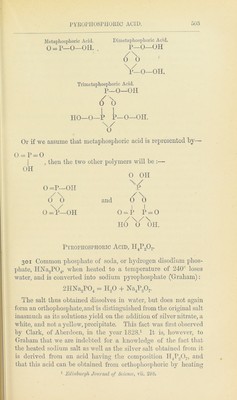
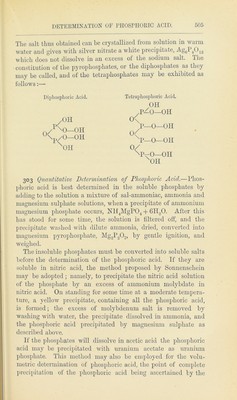
![form of large transparent monoclinic crystals by allowing a mixture of the sodium salt and nitrate of silver solution to stand for some days. In the same way the crystalline lead salt may be prepared by the substitution of nitrate (but not of acetate) of lead for the silver salt. (4) Tetrametaphosphates. The lead salt, Pb2P4012, is formed by treating oxide of lead with an excess of phosphoric acid and heating up to a temperature of 300°. If this is then decom- posed by sodium sulphide the sodium salt is obtained as a tetrametapliosphate. This, however, is not a crystalline salt but forms with a small quantity of water a viscid elastic mass and on the addition of a larger quantity of water a gum- like solution which will not pass through a filter. The tetrametaphosphates of the alkalis produce viscid precipitates with the soluble salts of the alkaline earths. If sodium dimetaphosphate is fused with copper dimetapliosphate and the mixture allowed gradually to cool a double compound having the composition CuNa2P4012 is formed (Fleitmann and llenneberg). (5) Hexameta phosphates. — The sodium salt, ]STa6P(.0]8, is obtained when fused sodium metaphospliate is allowed to cool slowly. It is a crystalline mass, deliquesces on exposure to the air, and produces with barium chloride a llocculent precipitate, and with the salts of the heavy metals gelatinous precipitates. It also forms characteristic double salts containing quantities of monad metal in the ratio of five to one or equivalent quantities of dyad metal, the calcium salt, for example, having the composition Ca5N’a2(P03)12 or (NaP03)2(Ca'T20(.)5. The metaphosphates which are soluble in water have a neutral or slightly acid reaction. When their solutions are boiled they are converted into orthophosphates. All the metaphosphates undergo this change on boiling with nitric acid or when they are fused with an alkali. The different varieties of metapliosphates are derived from acids, all of which possess the same composition, but differ, as the double salts show, from one another in molecular weight. Compounds of this description are termed polymeric bodies. The constitution of these hypothetical acids may be represented graphically as follows :—](https://iiif.wellcomecollection.org/image/b28122409_0001_0520.jp2/full/800%2C/0/default.jpg)