Volume 1
A treatise on chemistry / by H.E. Roscoe and C. Schorlemmer.
- Henry Enfield Roscoe
- Date:
- 1877-1892
Licence: Public Domain Mark
Credit: A treatise on chemistry / by H.E. Roscoe and C. Schorlemmer. Source: Wellcome Collection.
610/792 page 594
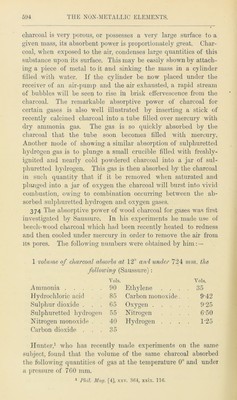
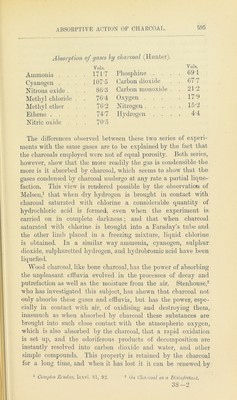
![charcoal is very porous, or possesses a very large surface to a given mass, its absorbent power is proportionately great. Char- coal, when exposed to the air, condenses large quantities of this substance upon its surface. This may be easily shown by attach- ing a piece of metal to it and sinking the mass in a cylinder tilled with water. If the cylinder be now placed under the receiver of an air-pump and the air exhausted, a rapid stream of bubbles will be seen to rise ill brisk effervescence from the charcoal. The remarkable absorptive power of charcoal for certain gases is also well illustrated by inserting a stick of recently calcined charcoal into a tube filled over mercury with dry ammonia gas. The gas is so quickly absorbed by the charcoal that the tube soon becomes filled with mercury. Another mode of showing a similar absorption of sulphuretted hydrogen gas is to plunge a small crucible filled with freshly- ignited and nearly cold powdered charcoal into a jar of sul- phuretted hydrogen. This gas is then absorbed by the charcoal in such quantity that if it be removed when saturated and plunged into a jar of oxygen the charcoal will burst into vivid combustion, owing to combination occurring between the ab- sorbed sulphuretted hydrogen and oxygen gases. 374 The absorptive power of wood charcoal for gases was first investigated by Saussure. In his experiments he made use of beech-wood clnircoal which had been recently heated to redness and then cooled under mercury in order to remove the air from its pores. The following numbers were obtained by him: — 1 volume of charcoal absorbs at 12° and under 724 mm. the following (Saussure): Yds. Yds. Ammonia 00 Ethylene . . . . 35 Hydrochloric acid . . 85 Carbon monoxide. 9-42 Sulphur dioxide . . . 65 Oxygen .... 9-25 Sulphuretted hydrogen 55 Nitrogen . . . . 6-50 Nitrogen monoxide . 40 Hydrogen . . . 1-25 Carbon dioxide . . . 35 Hunter,1 who has recently made experiments on the same subject, found that the volume of the same charcoal absorbed the following quantities of gas at the temperature 0° and under a pressure of 760 mm. 1 Phil. Mag. [4], xxv. 3(54, xxix. 11G.](https://iiif.wellcomecollection.org/image/b28122409_0001_0612.jp2/full/800%2C/0/default.jpg)