Volume 1
A treatise on chemistry / by H.E. Roscoe and C. Schorlemmer.
- Henry Enfield Roscoe
- Date:
- 1877-1892
Licence: Public Domain Mark
Credit: A treatise on chemistry / by H.E. Roscoe and C. Schorlemmer. Source: Wellcome Collection.
657/792 page 641
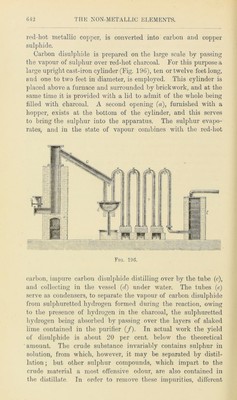
![CARBON AND SULPHUR G41 slightly soluble in pure, and insoluble in acidified water. Its salts have been as yet but slightly investigated. Neither charcoal nor diamond yields similar compounds, and Brodie believes that graphite may be considered to be a peculiar radical, to which he gives the name of graphon. According to Berthelot only natural graphite forms the above compound, whilst iron graphite, as well as that found in the Cranbourne meteorite, yields a chestnut brown powder on similar treat- ment.1 Diamond is not attacked by this oxidizing mixture, whilst ordinary charcoal is converted into a brown mass, soluble in water. Berthelot has made use of this property for the purpose of estimating the quantity of charcoal, graphite, and diamond present in a mixture.2 The finely powdered substance is treated by the method described for the preparation of graphitic acid ; care, however, must be taken that not more than five grams of the mixture are used at once, as otherwise explo- sions may take place. In order to separate the diamond from the graphitic acid, the residue is gently ignited, and again treated with the oxidizing mixture. The process is repeated until the whole of the graphitic acid has disappeared, but any diamonds which may be present remain unaltered. CARBON AND SULPHUR. Carbon Disulhiide, CS2. Vapour Density = 37 96. 398 Carbon forms only one compound with sulphur. This was accidentally discovered by Lampadius 111 1796, by heating pyrites with charcoal. In their investigation of carbonic oxide in the year 1802, Clement and Desonnes wished to ascertain whether charcoal invariably contained combined hydrogen; they examined the action of sulphur on red-hot charcoal, and obtained the same liquid which had been previously discovered by Lampadius. This liquid they first believed to be a compound of hydrogen and sulphur, but they soon convinced themselves that it only contained carbon and sulphur. Notwithstanding these experiments, the nature of the compound remained doubt- ful, until Vauquelin ascertained that its vapour, passed over 1 Comptcs Rendus, Ixviii. 183, 259, 334, 392, and 445. 2 Ann.Chim. Rhys. [4], xix 399.](https://iiif.wellcomecollection.org/image/b28122409_0001_0659.jp2/full/800%2C/0/default.jpg)