Volume 1
A treatise on chemistry / by H.E. Roscoe and C. Schorlemmer.
- Henry Enfield Roscoe
- Date:
- 1877-1892
Licence: Public Domain Mark
Credit: A treatise on chemistry / by H.E. Roscoe and C. Schorlemmer. Source: Wellcome Collection.
670/792 page 654
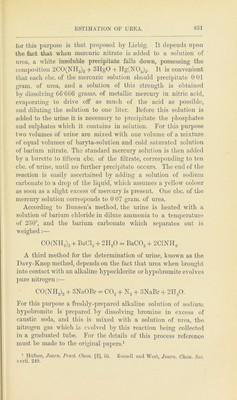
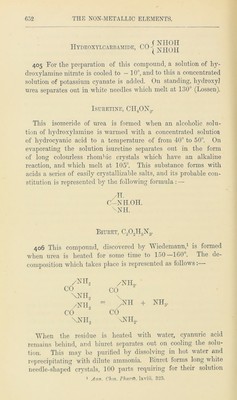
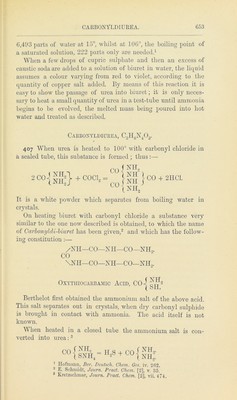
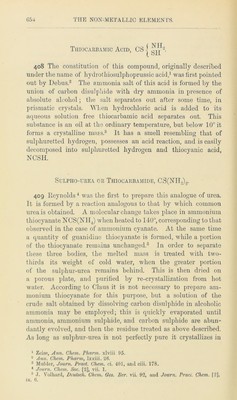
![Thiocarbamic Acid, CS | 408 The constitution of this compound, originally described under the name of hydrothiosulphoprussic acid,1 was first pointed out by Debus.2 The ammonia salt of this acid is formed by the union of carbon disulphide with dry ammonia in presence of absolute alcohol; the salt separates out after some time, in prismatic crystals. When hydrochloric acid is added to its aqueous solution free thiocarbamic acid separates out. This substance is an oil at the ordinary temperature, but below 10° it forms a crystalline mass.3 It has a smell resembling that of sulphuretted hydrogen, possesses an acid reaction, and is easily decomposed into sulphuretted hydrogen and thiocyanic acid, NCSH. SULPHO-UREA OR THIOCARBAMIDE, CS(NTT2)2. 409 Reynolds4 was the first to prepare this analogue of urea. It is formed by a reaction analogous to that by which common urea is obtained. A molecular change takes place in ammonium thiocyanate NCS(NII4) when heated to 140°, corresponding to that observed in the case of ammonium cyanate. At the same time a quantity of guanidine thiocyanate is formed, while a portion of the thiocyanate remains unchanged.5 In order to separate these three bodies, the melted mass is treated with two- thirds its weight of cold water, when the greater portion of the sulphur-urea remains behind. This is then dried on a porous plate, and purified by re-crystallization from hot water. According to Claus it is not necessary to prepare am- monium thiocyanate for this purpose, but a solution of the crude salt obtained by dissolving carbon disulphide in alcoholic ammonia may be employed; this is quickly evaporated until ammonia, ammonium sulphide, and carbon sulphide are abun- dantly evolved, and then the residue treated as above described. As long as sulphur-urea is not perfectly pure it crystallizes in 1 Zeise, Ann. Chem. Pharm. xlviii 95. 2 Ann. Chem. Pharm,, lxxiii. 26. 3 Mulder, Journ. Pract. Chem. ci. 401, and ciii. 178. 1 Journ. Chem. Soc. [2], vii. 1. 5 J. Volhard, Dcutsch. Chem. Ges. Ber. vii. 92, and Journ. Praci. Chem. [2],](https://iiif.wellcomecollection.org/image/b28122409_0001_0672.jp2/full/800%2C/0/default.jpg)