The effect of severe and prolonged muscular work on food consumption, digestion, and metabolism / by W. O. Atwater, PH.D., and H. C. Sherman, PH.D., and the mechanical work and efficiency of bicyclers, by R. C. Carpenter, M.S.
- Wilbur Olin Atwater
- Date:
- 1901
Licence: Public Domain Mark
Credit: The effect of severe and prolonged muscular work on food consumption, digestion, and metabolism / by W. O. Atwater, PH.D., and H. C. Sherman, PH.D., and the mechanical work and efficiency of bicyclers, by R. C. Carpenter, M.S. Source: Wellcome Collection.
Provider: This material has been provided by the Augustus C. Long Health Sciences Library at Columbia University and Columbia University Libraries/Information Services, through the Medical Heritage Library. The original may be consulted at the the Augustus C. Long Health Sciences Library at Columbia University and Columbia University.
26/78 page 22
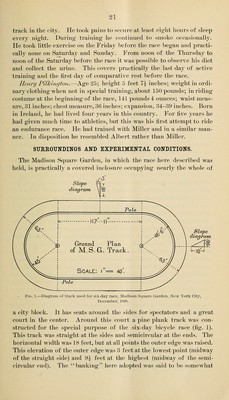
![greater than had ])een uyed in previous ,six-day contests, but decidedly less than is usually found on tracks constructed for racing- at high speed. A heavy black line, the ''pole, was drawn around the track 18 inches from the inside edge, as close as it would be practicable to ride at a moderate rate of speed, and served as a sort of guide for the riders. The length of this line was intended to be exactly one-tenth of a mile and was so considered in making up the official record (fig. 1). The contestants, however, did not follow the pole exactly and were apt to ride outside of it, especially when attempting to pass one another. In consequence the distance actually covered was somewhat greater than the records show. Inside the track, along one of its straight sides, was a level space about 6 feet wide. A portion of this space was assigned to each rider. Here his food and drink were brought and handed to him, as described beyond (p. 32). The chemists who made the observations here reported occupied places in this space and had their balances and other appara- tus for weighing and sampling the food on tables here. While engaged in the observations they did not leave this space except to accompany the riders to their quarters. To enable the latter to pass quickly between the track and their quarters, gatewaj^s were provided in the wall on the outer edge of the track at convenient points. Miller and Pilkington were quartered in a small room under one turn of the track and near one of the gateways just described. The room was practically without ventilation, was lighted only by gas, and was used to some extent as a kitchen and as a lounging room. The atmosphere was therefore rather bad, but the temperature of the room was kept at about normal. Most of the other riders, including Albert, were quartered in box stalls in the basement of the building, which had been in use during a horse show but a short time before. These stalls were dark and rather damp and cold. That occupied by Albert was farther from the track and on a lower floor than the room assigned to Miller, and each trip to it necessarily involved a greater loss of time. It is to be remembered, however, that the quarters were but little used. In none of the quarters was there running water, and usually only the hands, face, and feet of the riders were bathed. This is notable in contrast to the frequent bathing usually practiced by amateur athletes or those whose exertions are of short duration. Miller's legs were massaged at frequent intervals, and not infrequently, especially in the last half of the race, his head, neck, and legs were bathi^d with hot water, this being believed to induce wakefulness. As a residt of frequent though not altogether systematic observa- tions, the average temperature on the track was estimated as 58° to &P F. The variations in temperature were sufficient at times to be](https://iiif.wellcomecollection.org/image/b21229600_0026.jp2/full/800%2C/0/default.jpg)



 No text description is available for this image
 No text description is available for this image
 No text description is available for this image