A hand book of house sanitation : for the use of all persons seeking a healthy home / Enl. and revised by Eardley F. Bailey-Denton.
- John Bailey Denton
- Date:
- 1882
Licence: Public Domain Mark
Credit: A hand book of house sanitation : for the use of all persons seeking a healthy home / Enl. and revised by Eardley F. Bailey-Denton. Source: Wellcome Collection.
18/238 page 6
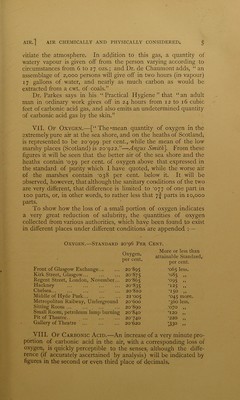
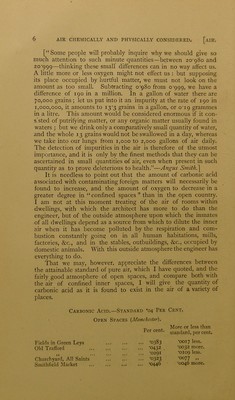
![[“ Some people will probably inquire why we should give so much attention to such minute quantities —between 20*980 and 20*999—thinking these small differences can in no way affect us. A little more or less oxygen might not effect us : but supposing its place occupied by hurtful matter, we must not look on the amount as too small. Subtracting 0*980 from 0*999, we have a difference of 190 in a million. In a gallon of water there are 70,000 grains; let us put into it an impurity at the rate of 190 in 1,000,000, it amounts to 13*3 grains in a gallon, or 0*19 grammes in a litre. This amount would be considered enormous if it con- sisted of putrifying matter, or any organic matter usually found in waters ; but we drink only a comparatively small quantity of water, and the whole 13 grains would not be swallowed in a day, whereas we take into our lungs from 1,000 to 2,000 gallons of air daily. The detection of impurities in the air is therefore of the utmost importance, and it is only by the finest methods that they can be ascertained in small quantities of air, even when present in such quantity as to prove deleterious to health.”—Angus Smith.'] It is needless to point out that the amount of carbonic acid associated with contaminating foreign matters will necessarily be found to increase, and the amount of oxygen to decrease in a greater degree in “ confined spaces ” than in the open country. I am not at this moment treating of the air of rooms within dwellings, with which the architect has more to do than the engineer, but of the outside atmosphere upon which the inmates of all dwellings depend as a source from which to dilute the inner air when it has become polluted by the respiration and com- bustion constantly going on in all human habitations, mills, factories, &c., and in the stables, outbuildings, &c., occupied by domestic animals. With this outside atmosphere the engineer has everything to do. That we may, however, appreciate the differences between the attainable standard of pure air, which I have quoted, and the fairly good atmosphere of open spaces, and compare both with the air of confined inner spaces, I will give the quantity of carbonic acid as it is found to exist in the air of a variety of places. Carbonic Acid.—Standard *04 Per Cent. Open Spaces [Manchester). Per cent. Fields in Green Leys -0383 Old Trafford ... *0432 . 99 •** *0291 Churchyard, All Saints *0323 Smithfield Market ... ... *0446 More or less than standard, per cent. *0017 less. •0032 more. •0109 less. •0077 „ *0046 more.](https://iiif.wellcomecollection.org/image/b28072388_0018.jp2/full/800%2C/0/default.jpg)