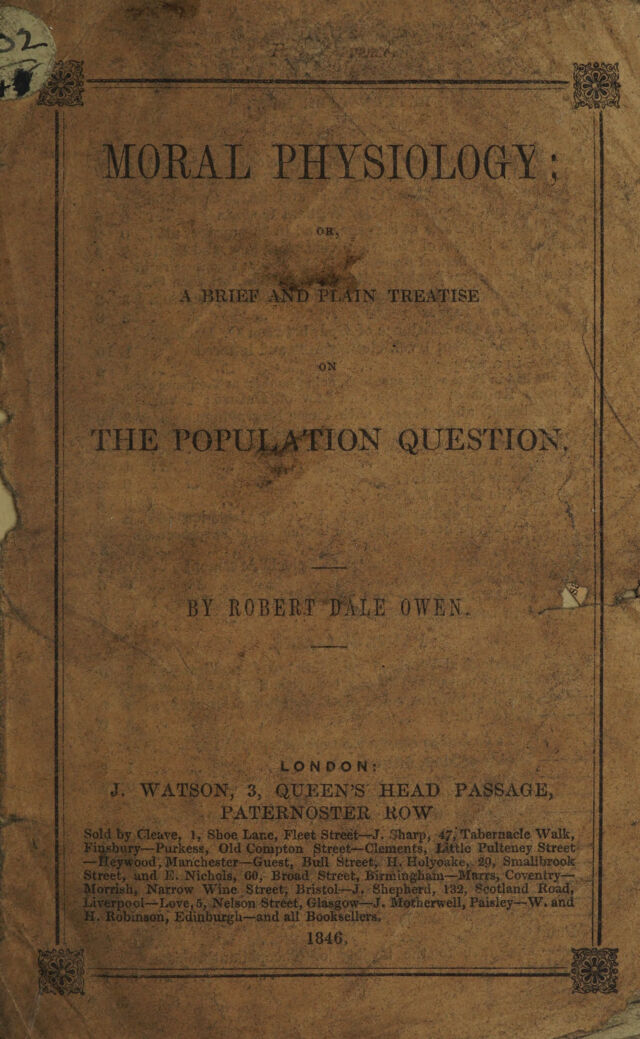
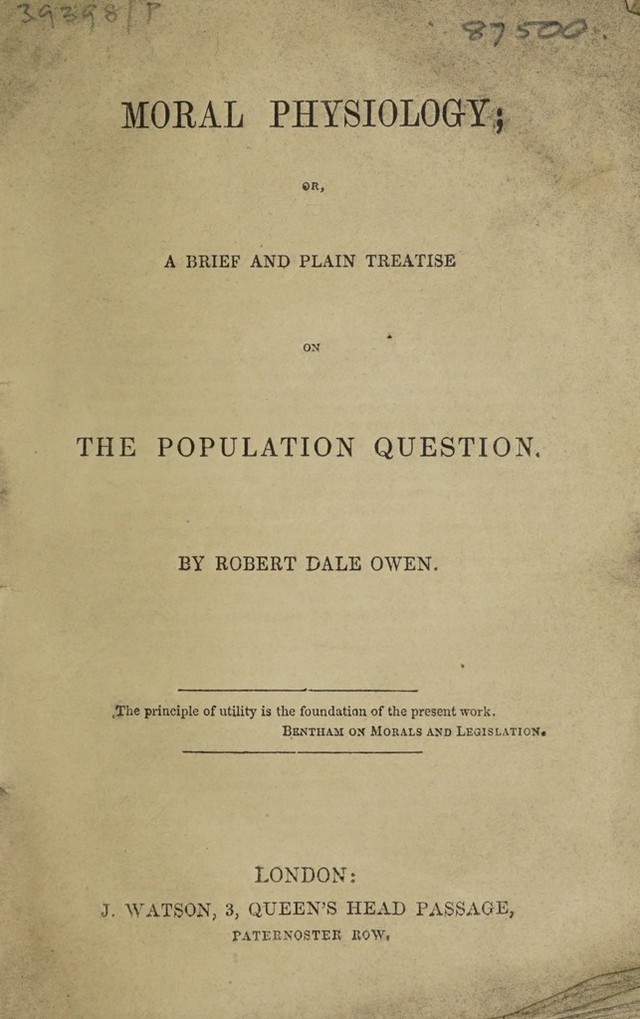
Moral physiology ; or, a brief and plain treatise on the population question / [Robert Dale Owen].
- Robert Dale Owen
- Date:
- [1846]
Licence: Public Domain Mark
Credit: Moral physiology ; or, a brief and plain treatise on the population question / [Robert Dale Owen]. Source: Wellcome Collection.
28/52 page 26
![and his industry, But even in this comparatively happy case, shall we count for nothing the years of ascetical sacrifice at which after- happiness is purchased ? The days of youth are not too many, nor its affections too lasting. We may, indeed, if a great object require it, sacrifice the one and mortify the other. But is this, in itself, desi¬ rable ] Does not wisdom tell us, that such sacrifice is a dead loss— to the warm-hearted often a grievous one ? Does not hisdom bid us temperately enjoy the spring-time of life, “ while the evil days come not, nor the years draw nigh, when we shall say, ‘ We have no pleasure in them ?” Let us say, then, if we will, that the youth who thus sacrifices the present for the future, chooses wisely between two evils, profli¬ gacy and asceticism. This is true. But let us not imagine the lesser evil to be a good. “ It is not good for man to be alone.” It is for no man’s or woman’s happiness or benefit, that they should be con¬ demned to Shakerism. It is a violence done to the feelings, and an injury to the character. A life of rigid celibacy, though pre¬ ferable to a life of dissipation, is yet fraught with many evils. Peevishness, restlessness, vague longings, and instability of cha¬ racter, are among the least of these. The mind is unsettled, and the judgment warped. Even the very instinct which is thus mortified assumes an undue importance, and occupies a portion of the thoughts which does not of right or nature belong to it; and which, during a life of satisfied affection, it would not obtain. I speak not now of extreme cases, where solitary vice or disease, or even insanity, has been the result of ascetical mortification. I speak of every day cases ; and I am well convinced, that, (however wise it often is, in the present state of the world, to select and adhere to this alternative,) yet no man or woman can live the life of a conscientious Shaker, without suffering, more or less, physically, mentally, and morally. This is the more to be regretted, because the very noblest portion of our species—the good, the pure, the high-minded, and the kind-hearted—are the chief victims. Thus, inasmuch as the scruple of incurring heavy responsibilities deters from forming moral connections, and encourages intempe¬ rance and prostitution, the knowledge which enables man to limit his offspring would, in the present state of tilings, save much unhappiness and prevent many crimes. Young persons sincerely attached to each other, and who might wish to marry, would many early ; merely resolving not to become parents until prudence permitted it. The young man, instead of solitary toil or vulgar dissipation, would enjoy the society and the assistance of her ho had chosen as his companion ; and the best years of life, whose pleasures never return, would not be squandered in riot, or lost through mortification. If, in virtue of these recommendations, early marriages should become common, and parents accustomed to limit the number of their children, they would have the best chance of forming their characters and watching their progress even to manhood, and live to see them settled in the world, instead of leaving them, whilst](https://iiif.wellcomecollection.org/image/b3036579x_0028.jp2/full/800%2C/0/default.jpg)