Vertebrate embryology : comprising the early history of the embryo and its foetal membranes / by J.W. Jenkinson.
- Jenkinson, J. W. (John Wilfred), 1871-1915.
- Date:
- 1913
Licence: In copyright
Credit: Vertebrate embryology : comprising the early history of the embryo and its foetal membranes / by J.W. Jenkinson. Source: Wellcome Collection.
92/368
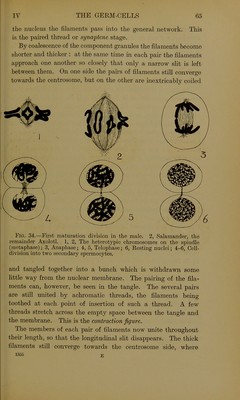
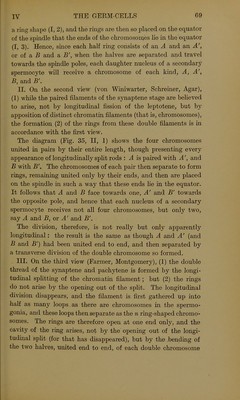
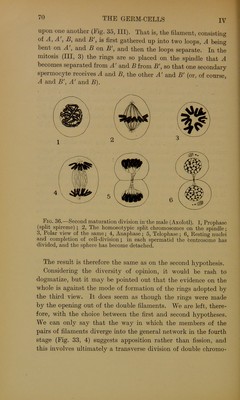
![IV apparently they end against the nuclear membrane. There is, therefore, not one continuous filament or spireme, but several. The other ends of the filaments pass into the tangle, which is still retracted from the nuclear membrane, but becoming looser as the nucleus enlarges. The coil is soon still more unravelled and occupies the whole of its side of the nucleus. This is the pachytene stage. The several filaments now separate from one another, so that the polar convergence is lost, and coil in various directions through the nucleus. At the same time the longitudinal slit reappears in each, and the filaments are once more paired, so reaching the diplotene condition. Their surfaces are still toothed where the connecting achromatic threads are inserted. Soon, however, these cross threads disappear and the filaments become smooth. At the same time the members of the several pairs begin to separate a little from one another, in places if not throughout their length. The nuclear membrane now breaks down and disappears, the pairs of filaments shorten and thicken, and assume the most various shapes and sizes. A pair may be in the form of two straight parallel rods, or two curved parallel rods, either V-shaped, or C -shaped, or two rods parallel at one, divergent at the other extremity, and so “]J~-shaped; or the slit between them may be expanded in two or more places, and then the two may be twisted over one another into a figure of £> or r}, or by expansion of the whole slit, while the rods are united at the ends, may be ring-shaped, while finally the ring may be pushed in in four places and assume the form of a cross, =[]=. These bizarre double bodies are the chromosomes of the first matura- tion division. It seems clear that they are derived from the separate paired filaments of the diplotene stage, these from the thick filaments of the pachytene stage, and these again from the paired filaments of the synaptene nucleus. The origin of these we shall have to discuss later on. The number of the double chromosomes, and therefore of the several double filaments in the earlier diplotene, pachytene, and synaptene stages, is one-half that seen hi the spermogonia.](https://iiif.wellcomecollection.org/image/b28105722_0092.jp2/full/800%2C/0/default.jpg)