Volume 1
The Roman antiquities of Dionysius Halicarnassensis / translated into English; with notes and dissertations. By Edward Spelman.
- Dionysius of Halicarnassus
- Date:
- 1758
Licence: Public Domain Mark
Credit: The Roman antiquities of Dionysius Halicarnassensis / translated into English; with notes and dissertations. By Edward Spelman. Source: Wellcome Collection.
39/532
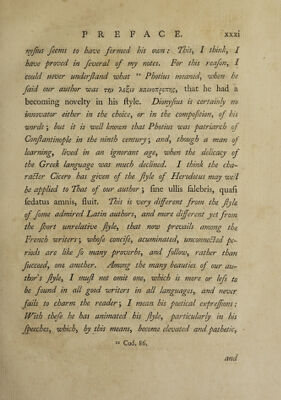
![nyfius feems to have formed his own: This, I think, / have proved in feveral of my notes. For this reafony I could never widerf and what 12 Photius meaned, when he faid our author was ty]v Mivongzzriz, that he had a becoming novelty in his ftyle. Dionyfius is certainly no mnovator either in the choice, or in the compofttion, of his words; but it is well known that Photius was patriarch of Confantinople in the ninth century; and) though a man of learnings lived in an ignorant agey when the delicacy of the Greek language was much declined* I think the cha¬ racter Cicero has given of the Jlyle of Herodotus may well he applied to That of our author; line ullis falebris, quail fedatus amnis, fluit. ‘This is very different from the Jlyle of fome admired Latin authors, and more different yet from the fhort unrelative Jlyle, that now prevails among the. French writers; whofe concife, acuminated\ unconnected pe¬ riods are like fo many proverbs, and follow, rather than fucceed) one another. Among the many beauties of our au¬ thor s ftyle^ I muft not omit oney which is more or lefts to be found in all good writers in all languagesand never fails to charm the reader; I mean his poetical exprefforts: With thefe he has animated his ftyle, particularly in his fpeeches, which, by this means, become elevated and patheticy 12 Cod, 86,](https://iiif.wellcomecollection.org/image/b3041331x_0001_0039.jp2/full/800%2C/0/default.jpg)