Volume 1
Medical research and the NHS reforms / House of Lords, Select Committee on Science and Technology.
- Great Britain. Parliament. House of Lords. Science and Technology Committee.
- Date:
- 1995
Licence: Open Government Licence
Credit: Medical research and the NHS reforms / House of Lords, Select Committee on Science and Technology. Source: Wellcome Collection.
120/132 page 118
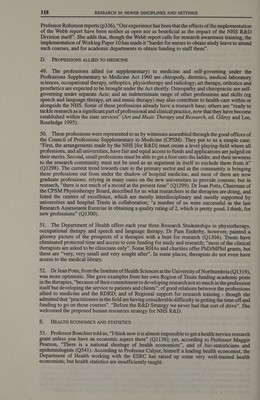
![Professor Robinson reports (p336), “Our experience has been that the effects of the implementation of the Webb report have been neither as open nor as beneficial as the impact of the NHS R&D Division itself’. She adds that, though the Webb report calls for research awareness training, the implementation of Working Paper 10 has made it “harder for nurses to obtain study leave to attend such courses, and for academic departments to obtain funding to staff them”. D. PROFESSIONS ALLIED TO MEDICINE 49. The professions allied (or supplementary) to medicine and self-governing under the Professions Supplementary to Medicine Act 1960 are chiropody, dietetics, medical laboratory sciences, occupational therapy, orthoptics, physiotherapy and radiology; art therapy, orthotics and prosthetics are expected to be brought under the Act shortly. Osteopathy and chiropractic are self- governing under separate Acts; and an indeterminate range of other professions and skills (eg speech and language therapy, art and music therapy) may also contribute to health care within or alongside the NHS. Some of these professions already have a research base; others are “ready to tackle research as a significant part of professional and clinical practice, now that they have become established within the state services” (Art and Music Therapy and Research, ed. Gilroy and Lee, Routledge 1995). 50. These professions were represented to us by witnesses assembled through the good offices of the Council of Professions Supplementary to Medicine (CPSM). They put to us a simple case: “First, the arrangements made by the NHS [for R&D] must create a level playing-field where all professions, and all universities, have fair and equal access to funds and applications are judged on their merits. Second, small professions must be able to get a foot onto the ladder, and their newness to the research community must not be used as an argument in itself to exclude them from it” (Q1298). The current trend towards care in the primary sector and in the community is bringing these professions out from under the shadow of hospital medicine, and most of them are now graduate professions, relying in many cases on the new universities to provide courses; but in research, “there is not much of a record at the present time” (Q1299). Dr Jean Potts, Chairman of the CPSM Physiotherapy Board, described for us what researchers in the therapies are doing, and listed the centres of excellence, which are mostly interdisciplinary and mostly supported by universities and hospital Trusts in collaboration; “a number of us were successful in the last Research Assessment Exercise in obtaining a quality rating of 2, which is pretty good, I think, for new professions” (Q1300). 51. The Department of Health offers each year three Research Studentships in physiotherapy, occupational therapy and speech and language therapy. Dr Pam Enderby, however, painted a gloomy picture of the prospects of a therapist with a bent for research (Q1304). Trusts have eliminated protected time and access to core funding for study and research; “most of the clinical therapists are asked to be clinicians only”. Some RHAs and charities offer PhD/MPhil grants, but these are “very, very small and very sought after”. In some places, therapists do not even have access to the medical library. 52. DrJean Potts, from the Institute of Health Sciences at the University of Northumbria (Q1319), was more optimistic. She gave examples from her own Region of Trusts funding academic posts in the therapies, “because of their commitment to developing research not so much in the profession itself but developing the service to patients and clients”; of good relations between the professions allied to medicine and the RDRD; and of Regional support for research training - though she admitted that “practitioners in the field are having considerable difficulty in getting the time off and funding to go on those courses”. “Before the R&D Strategy we never had that sort of drive”. She welcomed the proposed human resources strategy for NHS R&D. E. HEALTH ECONOMICS AND STATISTICS 53. Professor Bouchier told us, “I think now it is almost impossible to get a health service research grant unless you have an economic aspect there” (Q1138); yet, according to Professor Maggie Pearson, “There is a national shortage of health economists”, and of bio-statisticians and epidemiologists (Q541). According to Professor Culyer, himself a leading health economist, the Department of Health working with the ESRC has raised up some very well-trained health economists; but health statistics are insufficiently taught.](https://iiif.wellcomecollection.org/image/b32219337_0001_0120.jp2/full/800%2C/0/default.jpg)