Volume 1
Medical research and the NHS reforms / House of Lords, Select Committee on Science and Technology.
- Great Britain. Parliament. House of Lords. Science and Technology Committee.
- Date:
- 1995
Licence: Open Government Licence
Credit: Medical research and the NHS reforms / House of Lords, Select Committee on Science and Technology. Source: Wellcome Collection.
121/132 page 119
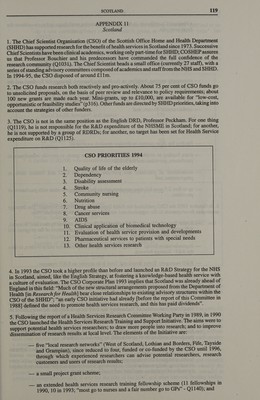
![APPENDIX 11 Scotland 1. The Chief Scientist Organisation (CSO) of the Scottish Office Home and Health Department (SHHD) has supported research for the benefit of health services in Scotland since 1973. Successive Chief Scientists have been clinical academics, working only part-time for SHHD; COSHEP assures us that Professor Bouchier and his predecessors have commanded the full confidence of the research community (Q1031). The Chief Scientist heads a small office (currently 27 staff), with a series of standing advisory committees composed of academics and staff from the NHS and SHHD. In 1994-95, the CSO disposed of around £11m. 2. The CSO funds research both reactively and pro-actively. About 75 per cent of CSO funds go to unsolicited proposals, on the basis of peer review and relevance to policy requirements, about 100 new grants are made each year. Mini-grants, up to £10,000, are available for “low-cost, opportunistic or feasibility studies” (p316). Other funds are directed by SHHD priorities, taking into account the strategies of other funders. 3. The CSO is not in the same position as the English DRD, Professor Peckham. For one thing (Q1119), he is not responsible for the R&D expenditure of the NHSME in Scotland; for another, he is not supported by a group of RDRDs; for another, no target has been set for Health Service expenditure on R&D (Q1125). CSO PRIORITIES 1994 Quality of life of the elderly Dependency Disability assessment Stroke Community nursing Nutrition Drug abuse Cancer services AIDS . Clinical application of biomedical technology . Evaluation of health service provision and developments . Pharmaceutical services to patients with special needs Other health services research 4. In 1993 the CSO took a higher profile than before and launched an R&D Strategy for the NHS in Scotland, aimed, like the English Strategy, at fostering a knowledge-based health service with a culture of evaluation. The CSO Corporate Plan 1993 implies that Scotland was already ahead of England in this field: “Much of the new structural arrangements proposed from the Department of Health [in Research for Health] bear close relationships to existing advisory structures within the CSO of the SHHD”; “an early CSO initiative had already [before the report of this Committee in 1988] defined the need to promote health services research, and this has paid dividends”. 5. Following the report of a Health Services Research Committee Working Party in 1989, in 1990 the CSO launched the Health Services Research Training and Support Initiative. The aims were to support potential health services researchers; to draw more people into research; and to improve dissemination of research results at local level. The elements of the Initiative are: _—_ five “local research networks” (West of Scotland, Lothian and Borders, Fife, Tayside and Grampian), since reduced to four, funded or co-funded by the CSO until 1996, through which experienced researchers can advise potential researchers, research customers and users of research results; — asmall project grant scheme; — an extended health services research training fellowship scheme (11 fellowships in 1990, 10 in 1993; “most go to nurses and a fair number go to GPs” - Q1140); and](https://iiif.wellcomecollection.org/image/b32219337_0001_0121.jp2/full/800%2C/0/default.jpg)