Volume 1
Medical research and the NHS reforms / House of Lords, Select Committee on Science and Technology.
- Great Britain. Parliament. House of Lords. Science and Technology Committee.
- Date:
- 1995
Licence: Open Government Licence
Credit: Medical research and the NHS reforms / House of Lords, Select Committee on Science and Technology. Source: Wellcome Collection.
53/132 page 51
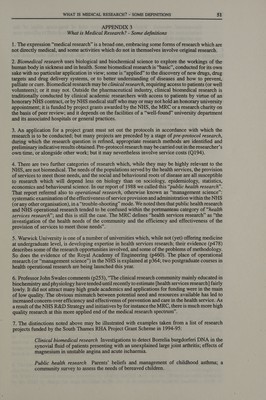
![APPENDIX 3 What is Medical Research? - Some definitions 1. The expression “medical research” is a broad one, embracing some forms of research which are not directly medical, and some activities which do not in themselves involve original research. 2. Biomedical research uses biological and biochemical science to explore the workings of the human body in sickness and in health. Some biomedical research is “basic”, conducted for its own sake with no particular application in view; some is “applied” to the discovery of new drugs, drug targets and drug delivery systems, or to better understanding of diseases and how to prevent, palliate or cure. Biomedical research may be clinical research, requiring access to patients (or well volunteers); or it may not. Outside the pharmaceutical industry, clinical biomedical research is traditionally conducted by clinical academic researchers with access to patients by virtue of an honorary NHS contract, or by NHS medical staff who may or may not hold an honorary university appointment; it is funded by project grants awarded by the NHS, the MRC or a research charity on the basis of peer review; and it depends on the facilities of a “well-found” university department and its associated hospitals or general practices. 3. An application for a project grant must set out the protocols in accordance with which the research is to be conducted; but many projects are preceded by a stage of pre-protocol research, during which the research question is refined, appropriate research methods are identified and preliminary indicative results obtained. Pre-protocol research may be carried out in the researcher’s own time, or alongside other work; but it may nevertheless involve service costs (Q194). 4. There are two further categories of research which, while they may be highly relevant to the NHS, are not biomedical. The needs of the populations served by the health services, the provision of services to meet those needs, and the social and behavioural roots of disease are all susceptible to research which will depend less on biology than on sociology, epidemiology, statistics, economics and behavioural science. In our report of 1988 we called this “public health research”. That report referred also to operational research, otherwise known as “management science”: systematic examination of the effectiveness of service provision and administration within the NHS (or any other organisation), in a “trouble-shooting” mode. We noted then that public health research and NHS operational research tended to be confused within the portmanteau category of “health services research”; and this is still the case. The MRC defines “health services research” as “the investigation of the health needs of the community and the efficiency and effectiveness of the provision of services to meet those needs”. 5. Warwick University is one of a number of universities which, while not (yet) offering medicine at undergraduate level, is developing expertise in health services research; their evidence (p478) describes some of the research opportunities involved, and some of the problems of methodology. So does the evidence of the Royal Academy of Engineering (p460). The place of operational research (or “management science’) in the NHS is explained at PoOs; two postgraduate courses in health operational research are being launched this year. 6. Professor John Swales comments (p253), “The clinical research community mainly educated in biochemistry and physiology have tended until recently to estimate [health services research] fairly lowly. It did not attract many high grade academics and applications for funding were in the main of low quality. The obvious mismatch between potential need and resources available has led to increased concern over efficiency and effectivenss of prevention and care in the health service. As aresult of the NHS R&D Strategy and initiatives by for instance the MRC, there is much more high quality research at this more applied end of the medical research spectrum”. 7. The distinctions noted above may be illustrated with examples taken from a list of research projects funded by the South Thames RHA Project Grant Scheme in 1994-95: Clinical biomedical research Investigations to detect Borrelia burgdorferi DNA in the synovial fluid of patients presenting with an unexplained large joint arthritis; effects of magnesium in unstable angina and acute ischaemia. Public health research Parents’ beliefs and management of childhood asthma; a community survey to assess the needs of bereaved children.](https://iiif.wellcomecollection.org/image/b32219337_0001_0053.jp2/full/800%2C/0/default.jpg)