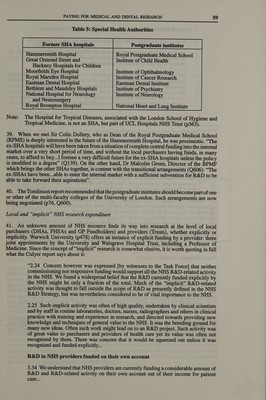
Volume 1
Medical research and the NHS reforms / House of Lords, Select Committee on Science and Technology.
- Great Britain. Parliament. House of Lords. Science and Technology Committee.
- Date:
- 1995
Licence: Open Government Licence
Credit: Medical research and the NHS reforms / House of Lords, Select Committee on Science and Technology. Source: Wellcome Collection.
62/132 page 60
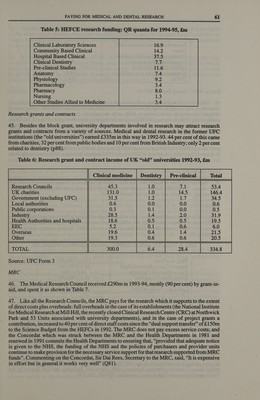
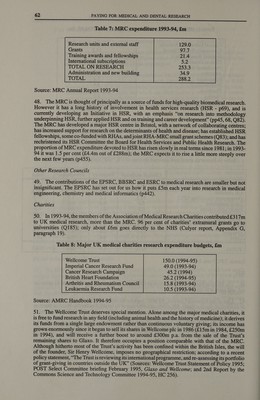
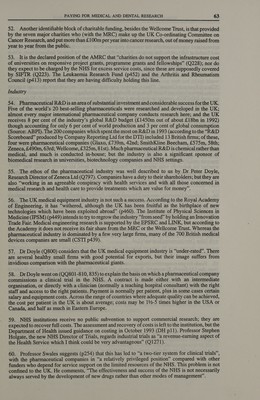
![3.36 It is helpful to consider this “implicit” activity in four categories: — _ work which is found to meet the national criteria for R&D (Appendix F); — projects which do not currently meet all the national criteria for R&D but which are nevertheless considered to be of sufficient value or potential value to the NHS in the short or long term to warrant continuing support; — pre-protocol and curiosity-driven exploration. Much work of this kind is undertaken by NHS clinical scientists and others with training and background in R&D (paragraph 2.25). It is the painstaking process of exploring and developing ideas, sometimes over many years, and which can often lead to a valuable R&D project or to a better service for the NHS generally. The work is firmly rooted in the day-to- day provision of clinical services and significantly enhances their quality and cost- effectiveness; and — work that is not worth supporting... Providers’ own account R&D [from Appendix G] 17 Providers fund a considerable amount of R&D, service support and R&D-related activity on their own account. Some of this is funded explicitly from their own special trustee accounts or through patient care contracts with the agreement of their purchasers. Much more is believed to be funded implicitly from patient care contracts. (Since a mechanism to identify and cost R&D in providers only became available in October 1993 we have to rely on the evidence of local surveys.) This implicit R&D activity embraces R&D sessions in consultants’ and other staff contracts, as well as possibly a considerable amount of unaccounted use of other NHS resources for R&D and service support for R&D, including the type of activities described in paragraph 2.25 of the report.” 42. Professor Peckham told us in November, “The identification of what we might call hidden or implicit research funds will be important if they are to be protected and ring-fenced, and that will require an effort, not just on our part but from the NHS and academic community more generally” (Q1). Professor Culyer told us in January, “The implicit research actually costs providers of health care money which at the moment is reflected in their prices. This is one of the reasons why the major research centres have higher prices and might lose out in the internal market. The sooner it can be identified and protected and removed, therefore, from the costing element in the market for health care, the better both for health care and for research” (Q516). When we met the NHS Director of Finance in February (Q556), work on this was still at an early stage. Higher Education Funding Councils 43. The HEFCs fund universities by block grant (p393), so it is not meaningful to ask how much support they give to medical research. It is however possible to say how much of the block grant is “earned” by medical research. Most of the “R” (research-related) element of each grant is calculated on the basis of the number of research-active staff in each department, combined with that department’s performance in the most recent RAE and weighted according to the relative expensiveness of the discipline. In England, “QR” calculated on this basis accounts for 95 per cent of R: for 1994-95, 20.5 per cent of QR (£120.5m out of £590m) was “earned” by medical subjects, 13 per cent by clinical medicine and dentistry and 7.5 per cent by non-clinical disciplines. 44. Itis also possible to say something about how much is spent on medicine in the universities. According to the CVCP, “University medical and dental departments spent about £350m from block grant and tuition fee income in 1992-93, including about £100m on research” (Briefing Note, November 1994).](https://iiif.wellcomecollection.org/image/b32219337_0001_0062.jp2/full/800%2C/0/default.jpg)