A text-book of inorganic chemistry / by Dr. A.F. Holleman ... Issued in English in coöperation with Hermon Charles Cooper.
- Arnold F. Holleman
- Date:
- 1912
Licence: In copyright
Credit: A text-book of inorganic chemistry / by Dr. A.F. Holleman ... Issued in English in coöperation with Hermon Charles Cooper. Source: Wellcome Collection.
29/556 (page 9)
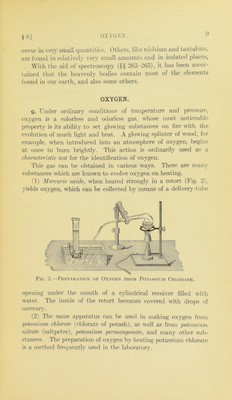
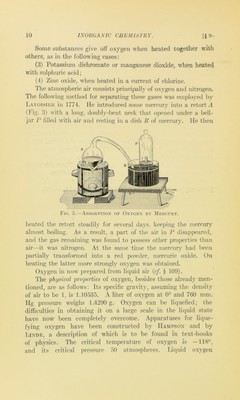
![§9.] OX YGEX. occur in very small quantities. Others, like niobium and tantalum, are found in relatively very small amounts and in isolated places, With the aid of spectroscopy (§§ 263-265), it has been ascer- tained that the heavenly bodies contain most of the elements found in our earth, and also some others. OXYGEN. Q. Under ordinary conditions of temperature and pressure, oxygen is a colorless and odorless gas, whose most noticeable property is its ability to set glowing substances on fire with the evolution of much light and heat. A glowing splinter of wood, for example, when introduced into an atmosphere of oxygen, begins at once to burn brightly. This action is ordinarily used as a characteristic test for the identification of oxygen. This gas can be obtained in various ways. There are many substances which are known to evolve oxygen on heating. fl) Mercuric oxide, when heated strongly in a retort (Fig. 2), yields oxygen, which can be collected by means of a delivery-tube Fig. 2.—Prepar.vtio.x of Oxygex from Pot.\ssium Chlor.\te. opening under the mouth of a cylindrical receiver filled witli water. The inside of the retort becomes covered with drops of mercury. (2) The same apparatus can be used in making oxygen from potassium chlorate, (chlorate of potash), as well as from potassium nitrate (saltpetre), potassium permanganate, and many other siil> stances. The preparation of oxygen by heating potassium chlorate is a method frequently used in the laboratory.](https://iiif.wellcomecollection.org/image/b28062851_0029.jp2/full/800%2C/0/default.jpg)