A text-book of inorganic chemistry / by Dr. A.F. Holleman ... Issued in English in coöperation with Hermon Charles Cooper.
- Arnold F. Holleman
- Date:
- 1912
Licence: In copyright
Credit: A text-book of inorganic chemistry / by Dr. A.F. Holleman ... Issued in English in coöperation with Hermon Charles Cooper. Source: Wellcome Collection.
31/556 (page 11)
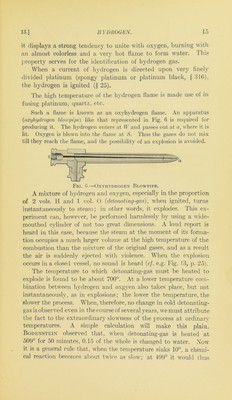
![10.] has a si)cciriC gravity of 1.124 (based on water) and a bcihnp-point of - 182.95° at 745.0 mm. pressure. Its color is light blue. It can be preserved for some time at ordinary pres- •sure, with the aid of a so-called vacuum-flask (Fig. 4.) The latter is a vessel enclosetl in an air-tight jacket, the space be- tween the walls being evacuated. 100 1. water at 0° dissolves 4.89 1. oxygen. The gas is also somewhat soluble in alcohol and in molten silver. When the silver solidifies, the oxygen—a volume about ten times that of the metal—suddenly escapes from solution, caus- ing j;eculiar elevations on the surface of the silver (“spitting” of silver). We remarked above (§ 7) that the solubility of gases in liquids diminishes with increasing tem- perature. A very remarkable law expresses the relation that exists between the solubility of a gas and its pressure, namely, the solubility is propor- tional to the pressure. This is the law of IIf.xry. Fig. 4. V.\cuum-Thus, when the pressure becomes «-fold, the solu- FLASK. bility also becomes a-fold. As the mass of a gas which is present in a certain volume is likewise proportional to tlie pressure, the law of Henry can also be expressed thus: The volume of a (jas dissolving in a certain quantity of a liquid is independent of the pressure. This law is rigid when the solubility of the gas is small; when the solubility is large, for instance 100 volumes in 1 of the li(piid, its deviations are considerable. Still another formulation of this law is of value in understanding certain of its applications: The concentrations of the dissolved and undissolved portions of a gas bear a constant ratio to each other. By “concentration” is meant the quantity of the gas in grams per unit volume (cubic centimeter). 10. .\mong the chemical properties of oxygen the most })romi- nont is its vigorous support of combustion. The following are interesting examples: Chareoal glows in air only moderately and without much evolu- tio!i of light. In oxygen, however, it l)urns with a bright glow. Sulphur, which burns in air with only a .small flame, burns in oxygen with an intense blue light. Phosphorus burns in oxygen](https://iiif.wellcomecollection.org/image/b28062851_0031.jp2/full/800%2C/0/default.jpg)