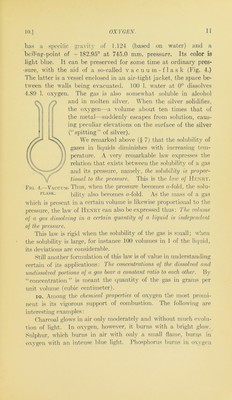
A text-book of inorganic chemistry / by Dr. A.F. Holleman ... Issued in English in coöperation with Hermon Charles Cooper.
- Arnold F. Holleman
- Date:
- 1912
Licence: In copyright
Credit: A text-book of inorganic chemistry / by Dr. A.F. Holleman ... Issued in English in coöperation with Hermon Charles Cooper. Source: Wellcome Collection.
34/556 (page 14)
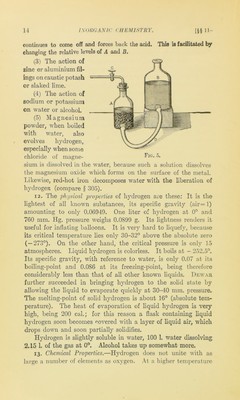
![continues to come off and forces back the acid. This is facilitated by changing the relative levels of A and B, (3) The action of zinc or aluminium fil- ings on caustic potash or slaked lime. (4) The action of sodium or potassium on water or alcohol. (5) Magnesium powder, when boiled with water, also evolves hydrogen, especially when some chloride of magne- sium is dissolved in the water, because such a solution dissolves the magnesium oxide which forms on the surface of the metal. Likewise, red-hot iron decomposes water with the liberation of hydrogen (compare § 305). 12. The physical properties of hydrogen are these: It is the lightest of all known substances, its specific gravity (air=l) amounting to only 0.06949. One liter of hydrogen at 0° and 760 mm. Hg. pressure weighs 0.0899 g. Its lightness renders it useful for inflating balloons. It is very hard to liquefy, because its critical temperature lies only 30-32° above the absolute zero (—273°). On the other hand, the critical pressure is only 15 atmospheres. Liquid hydrogen is colorless. It boils at - 252.5°. Its specific gravity, with reference to water, is only 0.07 at its boiling-point and 0.086 at its freezing-point, being therefore considerably less than that of all other known liquids. Dewar further succeeded in bringing hydrogen to the solid state by allowing the liquid to evaporate quickly at 30-40 mm. pressure. The melting-point of solid hydrogen is about 16° (absolute tem- perature). The heat of evaporation of liquid hydrogen is very high, being 200 cal.; for this reason a flask containing liquid hydrogen soon becomes covered with a layer of liquid air, which drops down and soon partially solidifies. Hydrogen is slightly soluble in water, 100 1. water dissolving 2.15 1. of the gas at 0°. Alcohol takes up somewhat more. 13. Chemical Properties.—Hydrogen does not unite with as large a numlier of elements as oxygen. At a higher tem]>erature](https://iiif.wellcomecollection.org/image/b28062851_0034.jp2/full/800%2C/0/default.jpg)