A text-book of inorganic chemistry / by Dr. A.F. Holleman ... Issued in English in coöperation with Hermon Charles Cooper.
- Arnold F. Holleman
- Date:
- 1912
Licence: In copyright
Credit: A text-book of inorganic chemistry / by Dr. A.F. Holleman ... Issued in English in coöperation with Hermon Charles Cooper. Source: Wellcome Collection.
35/556 (page 15)
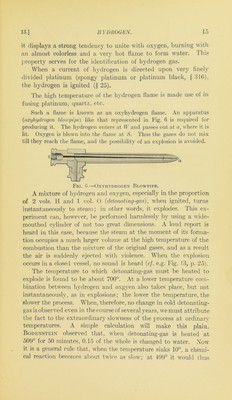
![it displays a strong tendency to unite with oxygen, burning with an almost colorless and a very hot flame to form water. This ])roperty serves for the identification of liydrogen gas. When a current of hydrogen is directed upon very finely divided platinum (spongy platinum or platinum black, § 316), the hydrogen is ignited (§ 25). The high temperature of the hydrogen flame is made use of in fusing platinum, quartz, etc. Such a flame is knoAATi as an oxyhydrogen flame. An apparatus {oxijhydrogen blowpipe) like that roj^resented in Fig. 6 is required for producing it. The hydrogen enters at 11' and passes out at a, where it is lit. O.xygen is blown into the flame at S. Thus the gases do not mix till they reach the flame, and the possibility of an explosion is avoided. A mixture of hydrogen and oxygen, especially in the proportion of 2 vols. H and 1 vol. (3 (detomting-gas), when ignited, turns instantaneously to steam; in other words, it explodes. This ex- periment can, however, be performed harmlessly by using a wide- mouthed cylinder of not too great dimensions. A loud report is heard in this case, because the steam at the moment of its forma- tion occupies a much larger volume at the high temperature of the combustion than the mixture of the original gases, and as a result the air is suddenly ejected with violence. When the explosion occurs in a closed vessel, no sound is heard (c/. e.g. Fig. 13, p. 25). The temperature to which detonating-gas must be heated to explode is found to be about 700°. At a lower temperature com- bination between hydrogen and oxgyen also takes place, but not instantaneously, as in explosions; the lower the temperature, the slower the process. When, therefore, no change in cold detonating- gas is observed even in the course of several years, we must attribute the fact to the extraordinary slowness of the process at ordinary temperatures. A simple calculation will make this plain. Bodenstein observed that, when detonating-gas is heated at 509° for 50 minutes, 0.15 of the whole is changed to water. Xow it is a general rule that, when the temperature sinks 10°, a chemi- cal reaction becomes about twice as slow; at 499° it would thus](https://iiif.wellcomecollection.org/image/b28062851_0035.jp2/full/800%2C/0/default.jpg)