A text-book of inorganic chemistry / by Dr. A.F. Holleman ... Issued in English in coöperation with Hermon Charles Cooper.
- Arnold F. Holleman
- Date:
- 1912
Licence: In copyright
Credit: A text-book of inorganic chemistry / by Dr. A.F. Holleman ... Issued in English in coöperation with Hermon Charles Cooper. Source: Wellcome Collection.
36/556 page 16
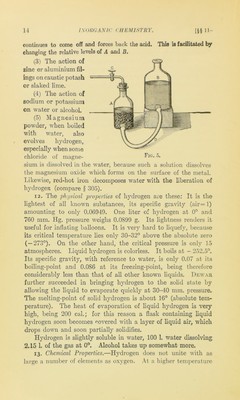
![[§§ 13- take 100 minutes till the 0.15 part of the gas had formed water. At the ordinary temperature, say at 9°, it would be 50X2^° minutes, that is about l.OGX 10“ years. The same can be said of all chemi- cal reactions. When we see that wood, sulphur, etc., burn quickly at higher temperatures, we must admit that oxidation takes, place also at ordinary temperatures, though so slowly that we cannot perceive it. 1\Ioissan, however, succeeded in proving that charcoal at 100° and sulphur at ordinary temperatures are oxidized very slowly in a current of oxygen. Hydrogen is not only able to unite with free oxygen, but it also has the power to withdraw oxygen from many of its compounds. The action of hydrogen on a compound is called, in general, reduction. This action is olten a ver}'^ useful means of determining whether a compound contains oxygen, since the latter, if ])resent, will usually unite with the hydrogen to form water. Copper oxide may serve as an example of the application of this method. A little is placed in a tube, hydrogen is led over it, and heat is then applied; one soon sees the black oxide change to red copper, and water depositing in drops on the colder parts of the tube. Many other oxides can be similarly reduced, e.g. iron oxide, lead oxide, etc. THE CONSERVATION OF lAIATTER. 14. The quantitative relationships in oxidizing and reducing processes, such as have been discussed in § 13, i.e. the relations of the masses of the substances participating in the changes, may be used to elucidate a very important law. A definite amount of copper powder, for example, may be placed in a tube and the weight of the tube with the powder ascertained. Oxygen is then led over the copper at a high temperature. The apparatus should be so arranged that the volume of the oxygen which combines with the copper can be measured. Wdien the oxidation process has proceeded for some time, the tube containing the oxidized copper is allowed to cool and then weighed. The weight is found to have increased, and the increase is just equal to the weight of the volmne of oxygen used up. Thereupon hydrogen is passed through the tube with the copper oxide and heat applied. Here also arrange- ments should be made for measuring the volume of hydrogen con- sumed in reduction. The reduction is allowed to go on until all the copper oxide is transformed back to copper. When the tube and powder are subsequently weighed, they will be found to have re-](https://iiif.wellcomecollection.org/image/b28062851_0036.jp2/full/800%2C/0/default.jpg)
 No text description is available for this image
 No text description is available for this image
 No text description is available for this image