A text-book of inorganic chemistry / by Dr. A.F. Holleman ... Issued in English in coöperation with Hermon Charles Cooper.
- Arnold F. Holleman
- Date:
- 1912
Licence: In copyright
Credit: A text-book of inorganic chemistry / by Dr. A.F. Holleman ... Issued in English in coöperation with Hermon Charles Cooper. Source: Wellcome Collection.
508/556 (page 488)
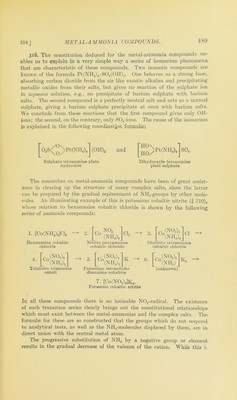
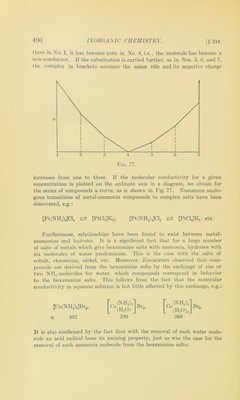
![Co(NIl3),X, a 402 Co(NH3)3X3 Co(NH3)^X, 245 117 Co(NH3)3X,. 7 with those of the salts: NagPO, MgCl, a 370 249 NaCI 125 we find that the first of the above complex salts must be a quaternary, the second a ternary, the third a binary, electroljde, and the fourth a non-elec- trolyte. The chemical properties of these compounds accord perfectly with this theory. In the compound, Co(NH3)4Cl3, formerly called “praseo-cobalt chloride,’' only one chlorine can be directly precipitated by silver nitrate; in Co(NIl3)5Cl3 two can be so precipitated, while in Co(NH3)g('l3, hexammine cobaltic chloride, all three chlorine atoms apjjear to be ionized in aqueous solution, since all three react at once with a silver salt solution. This is explained on the assumption that the added ammonia molecules displace the acid radicals from their immediate connection with the metal atom and themselves enter into this direct union with the metal. In order to distin- guish the ammonia molecules which are linked up in this way Werner applies to them the term amrnine and devises the following formula* and names to express the constitution of the above-named compounds; M(NH3)3X3 Tri-acido triammine compounds [M(NH3)3X3], M(NH3)4X3 Di-acido tetrammine salts [M(NH3)4X,]X, M(NH3)jX3 Acido pentammine saltt [M(NIl3)5X]X2, M(NIl3)eX3 Hexammine salts [M(NIl3)6]X3, the atoms or groups within brackets being regarded as in direct union with the metal atom. The ionizable groups X outside of the brackets are in indirect union with the complex and, according to Werner, are not joined to a definite elemental atom. If we compare the composition of the various metal-ammonia.s, we find that the formation of complexes is not without its limitations, but that after the addition of a definite number of Nib-molecules it comes to an end. Particularly sharp is the limit in respect to the number of groups which can unite directly with an atom serving as the center of a complex radical. It is a striking fact that this limit is the same for a good many elements and is commonly six (6). It seems most likely that this limiting number is characteristic of the elemental atom and of considerable importance. AVer- ner calls it the coordination number and defines it as the maximum number of individual groups that can be directly united to an elemental atom. As already stated, the coordination number for most elements is 6; for a few elements, boron, carbon, and nitrogen, it is 4.](https://iiif.wellcomecollection.org/image/b28062851_0508.jp2/full/800%2C/0/default.jpg)