Lectures on clinical medicine, delivered in the Hospital Saint-Jacques, of Paris / by P. Jousset ; translated, with copious notes and additions, by R. Ludlam.
- Pierre Jousset
- Date:
- 1880
Licence: Public Domain Mark
Credit: Lectures on clinical medicine, delivered in the Hospital Saint-Jacques, of Paris / by P. Jousset ; translated, with copious notes and additions, by R. Ludlam. Source: Wellcome Collection.
28/540 page 6
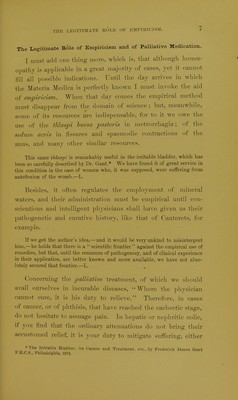
![plain themselves. From the first he luid been reiDulsed, lie had lived alone, a target for the persecutions of those to whom he was conscious of being superior; and then, after all sorts of misfortunes, came success, and with success, flat- tery and adulation and all the intoxication of triumph. Sur- rounded by disciples, whose heads were turned with what he had done, — the acknowledged master and leader,— he imag- ined himself to be almost infallible^ and fancied that his mission wonld not be accomplished nntil he had explained everything in medicine. He accordingly formulated a pathol- ogy, and also a physiology, as he had formulated a system of therapeutics. Such, gentlemen, was the origin of the triple dynamism which is physiological, therapeutical and pathological. I can- not enter into a discussion of this error, for it would carry me too far from my subject, and besides it is unnecessary, for the followers of this extreme view are ]iot so numerons as they were. For myself, I am quite of the opinion of my teacher, Tessier, who made a resume of this cpiestion in these words : The doctrine of Samuel Hahnemann may be divided into two parts, viz., pathology and therapeutics. Term for term, the one comprehends all of his errors and the other all of his truths. So that, in speaking of the pathology, or the errors, of Hahnemann, we mean the same thing; and his therapeutics, or his truths, are also identical. Consequent- ly, in what is called homoeopathy there is the hemisphere of error and the hemisphere of truth. Far from admitting' the triple dynamism in physiology, we accept the doctrine of a substaiitial union of body and spirit; in pathology we are essentialists,—that is to say, we consider diseases as distinct species, not constituting veritable entities, but to be described and studied as belonging to the natural species.](https://iiif.wellcomecollection.org/image/b20401929_0028.jp2/full/800%2C/0/default.jpg)

 No text description is available for this image
 No text description is available for this image
 No text description is available for this image