Volume 1
A text-book of physiology / by Henry P. Bowditch [and others] ; edited by William H. Howell.
- Date:
- 1900
Licence: Attribution-NonCommercial 4.0 International (CC BY-NC 4.0)
Credit: A text-book of physiology / by Henry P. Bowditch [and others] ; edited by William H. Howell. Source: Wellcome Collection.
Provider: This material has been provided by the Royal College of Physicians of Edinburgh. The original may be consulted at the Royal College of Physicians of Edinburgh.
554/608 (page 550)
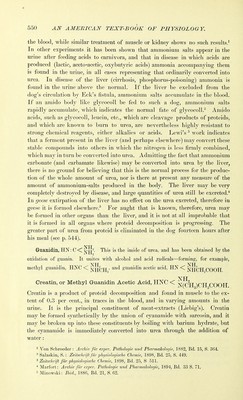
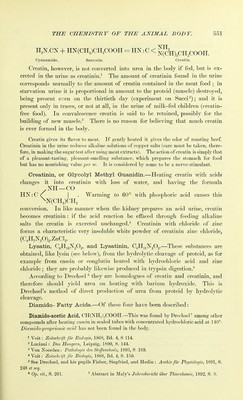
![the blood, while similar treatment of muscle or kidney shows no such results.' In other experiments it has been shown that ammonium salts appear in the urine after feeding acids to carnivora, and that in disease in which acids are produced (lactic, aceto-acetic, oxybutyric acids) ammonia accompanying them is found in the urine, in all cases representing that oi'dinarily converted into urea. In disease of the liver (cirrhosis, phosphorus-poisoning) ammonia is found in the urine above the normal. If the liver be excluded from the dog's circulation by Eck's fistula, ammonium salts accumulate in the blood. If an araido body like glycocoH be fed to such a dog, ammonium salts rapidly accumulate, Avhich indicates the normal fate of glycocoU.^ Amido acids, such as glycocoll, leucin, etc., which are cleavage products of proteids, and which are known to burn to urea, are nevertheless highly resistant to strong chemical reagents, either alkalies or acids. Lewi's ^ work indicates that a ferment present in the liver (and perhaps elsewhere) may convert these stable compounds into others in which the nitrogen is less firmly combined, which may in turn be converted into urea. Admitting the fact that ammonium carbonate (and carbamate likewise) may be converted into urea by the liver, there is no ground for believing that this is the normal process for the produc- tion of the whole amount of urea, nor is there at present any measure of the amount of ammonium-salts produced in the body. The liver may be very completely destroyed by disease, and large quantities of urea still be excreted.* In geese extirpation of the liver has no effect on the urea excreted, therefore in geese it is formed elsewhere.* For aught that is known, therefore, urea may be formed in other oi'gans than the liver, and it is not at all improbable that it is formed in all organs where proteid decomposition is progressing. The greater part of urea from proteid is eliminated in the dog fourteen hours after his meal (see p. 544). NTT Guanidin, HN: C-<]>^jj'^- This is the imide of urea, and has been obtained by the oxidation of guanin. It unites with alcohol and acid radicals—forming, for example, methyl guanidin, HNC <i > and guanidin acetic acid, HN <C COOH Creatin, or Methyl Guanidin Acetic Acid, HNC < ]sr(CH )CIT COOH Creatin is a product of proteid decomposition and found in muscle to the ex- tent of 0.3 per cent., in traces in the blood, and in varying amounts in the urine. It is the principal constituent of meat-extracts (liiebig's). Creatin may be formed synthetically by the union of cyanamide with sarcosin, and it may be broken up into these constituents by boiling with barium hydrate, but the cyanamide is immediately converted into urea through the addition of water: ' Von Schroeder : Archiv fur eorper. Pathologic unci Pharmakologie, 1882, Bd. 15, S. 364. ' Salaskin, S. : Zeitsehrift fur physwlogische Chemie, 1898, Bd. 25, S. 449. ^ Zeitsclirift fur physiologische Chemie, 1898, Bd. 25, S 511. * Marfort: Archiv fur exper. Pathologic und Pharmakologie, 1894, Ed. 33 S. 71. 5 Minowski: Ibid., 1886, Bd. 21, S. 62.](https://iiif.wellcomecollection.org/image/b21981735_0001_0556.jp2/full/800%2C/0/default.jpg)