Volume 1
A text-book of physiology / by Henry P. Bowditch [and others] ; edited by William H. Howell.
- Date:
- 1900
Licence: Attribution-NonCommercial 4.0 International (CC BY-NC 4.0)
Credit: A text-book of physiology / by Henry P. Bowditch [and others] ; edited by William H. Howell. Source: Wellcome Collection.
Provider: This material has been provided by the Royal College of Physicians of Edinburgh. The original may be consulted at the Royal College of Physicians of Edinburgh.
555/608 (page 551)
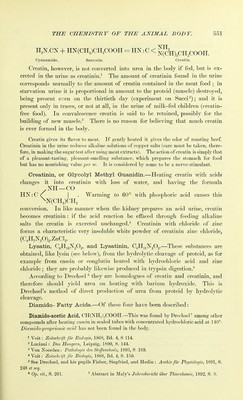
![H^N.CN + HN(CH3)CH2COOH = HN: C < n^h)3CH2COOH. Cyanamide. Sarcosin. Creatin. Creatin, however, is not converted into urea in the body if fed, but is ex- creted in the urine as creatinin.^ The amount of creatinin found in the urine corresponds normally to the amount of creatin contained in the meat food ; in starvation urine it is proportional in amount to the proteid (muscle) destroyed, being present even on the thirtieth day (experiment on Succi'^); and it is present only in traces, or not at all, in the urine of milk-fed children (creatin- free food). In convalescence creatin is said to be retained, possibly for the building of new muscle.* There is no reason for believing that much creatin is ever formed in the body. Creatin gives its flavor to meat. If gently heated it gives the odor of roasting beef. Creatinin in the urine reduces alkaline solutions of copper salts (care must be taken, there- fore, in making the sugar test after using meat extracts). The action of creatin is simply that of a pleasant-tasting, pleasant-smelling substance, which prepares the stomach for food but has no nourishing value per se. It is considered by some to be a nerve-stimulant. Creatinin, or Glycolyl Methyl Guanidin.—Heating creatin with acids changes it into creatinin with loss of Avater, and having the formula NH—CO HN:C^ I . Warming to 60° with phosphoric acid causes this \N(CH3)CH2 conversion. In like manner when the kidney prepares an acid urine, creatin becomes creatinin : if the acid reaction be effaced through feeding alkaline salts the creatin is excreted unchanged.* Creatinin with chloride of zinc forms a characteristic very insoluble white powder of creatinin zinc chloride, (C,H,N30),.ZnCl3. Lysatin, CgIIj3]Sr202, and Lysatinin, CgIInN302.—These substances are obtained, like lysin (see below), from the hydrolytic cleavage of proteid, as for example from casein or conglutin heated with hydrochloric acid and zinc chloride; they are probably likewise produced in trypsin digestion.^ According to Drechsel ^ they are homologues of creatin and creatinin, and therefore should yield urea on heating with barium hydroxide. This is Drechsel's method of direct production of urea from proteid by hydrolytic cleavage. Diamido- Fatty Acids.—Of these four have been described: Diamido-acetic Acid, CH(NH2)2COOH.—This was found by Drechsel' among other compounds after heating casein in sealed tubes with concentrated hydrochloric acid at 140°- Diamido-proprionic acid has not been found in the body. » Voit: Zeitschrift fur Biologic, 1868, Bd. 4, S 114. ^ Luciani: Das Hungern, Leipzig, 1890, S. 144. ^ Von Noorden : Pathologic des Stoffwechsels, 1893, S. 169. * Voit: Zeitschrift fur Biologic, 1868, Bd. 4, S. 150. * See Drechsel, and his pupils Fislier, Siegfried, and Hedin : Archiv fiir Physiologic, 1891, S. 248 et seq. * Op. cit, S. 261. ' Abstract in Maly's Jahresbcricht iXhcr Thierchemic, 1892, S. 9.](https://iiif.wellcomecollection.org/image/b21981735_0001_0557.jp2/full/800%2C/0/default.jpg)