Volume 1
A text-book of physiology / by Henry P. Bowditch [and others] ; edited by William H. Howell.
- Date:
- 1900
Licence: Attribution-NonCommercial 4.0 International (CC BY-NC 4.0)
Credit: A text-book of physiology / by Henry P. Bowditch [and others] ; edited by William H. Howell. Source: Wellcome Collection.
Provider: This material has been provided by the Royal College of Physicians of Edinburgh. The original may be consulted at the Royal College of Physicians of Edinburgh.
578/608 (page 574)
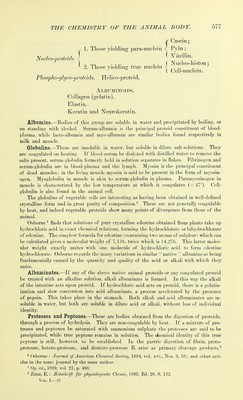
![hgemochromogen, which is a crystallizable cleavage-product of haemoglobin. According to Hoppe-Sej'ler the oxygen in oxyhjemoglobin is bound to the haemochroniogen group. Haemochromogen treated with a strong dehydrating agent is converted, with elimination of iron, into hcematoporpliyriii, CieHigNoOa, an isomer of bilirubin. Hismatoporphyrin is said to occur in normal urine.' Hgematoporphyrin treated with nascent hydrogen is converted into a body believed to be identical with hydro- or urobilirubin. Analogous to this is the work of the liver in the body, manufacturing the biliary coloring matter from haemoglobin, and retaining the separated iron for tlie synthesis of fresh haemoglobin (see p. 529). Hcematoidin^ found in old blood-stains, is believed to be identical with bilinxbin. The Bile-pigments.—The ordinary coloring matter of yellow human bile is bilirubm, C32H38N4O6. The next higher oxidation-product is the green hiliverdin, CgjHjjN^Of,, which is the usual dominant color in the bile of herbivora. These coloring-matters and others derived fi'om them have been found in gall-stones. Jolles^ gives the following products of the oxidation of bilirubin : Bilirubin (red) Biliverdin (green) Bilicyanin (blue) (violet) (red) (brown) Bilixanthin (brownish-yellow) If nitric acid containing a little nitrous acid be added to a solution ol bilirubin, a play of colors is observed at the juncture of the two fluids, undoubtedly de])ending upon various stages of oxidation. Above is a ring of green (biliverdin), then blue and violet (bilicya- nin), red, yellowish-brown (bilixanthin). Bilixanthin (= choletelin) is the highest oxida- tion-product. The above is known as Gmelins test} If bilirubin or biliverdin is subjected to the action either of nascent hydrogen or of putrefaction it is reduced to hydrobilirubin, Ca2ll44N407. This substance is therefore formed in the intestinal tract, is in part absorbed, and appears in the urine, where it is called urobilin, though the two are identical. Urobilin gives a yellowish coloration to the urine. Injection into the blood-vessels of distilled water, ether, chloroform, the biliary salts, or arsenuretted hydrogen, produces a solution of the red blood-corpuscles and conver- sion of haemoglobin into biliary coloring matters which are thrown out in the urine. Bili- rubin, biliverdin, and bilicyanin give characteristic spectra. Melanins.—Under this name are classed the pigments of the skin, of the retina, and of the iris. In melanosis and kindred diseases they are deposited in black granules. Abel and Davis * prepared pure pigment from the skin of the negro and find that it con- tains no iron and 1.5 per cent, of sulphur. These pigments arise from proteid. On decomposition they yield two melaninic acids.^ Tryptophan.—This is said to be a cleavage-product of hemipeptone in tryptic diges- tion ; * it gives a red color with chlorine and a violet color with bromine, due to halogen- addition compounds. Lipochromes.—These include lutein, the yellow pigment of the corpus luteum, of 1 Garrod: Journal of Physiology, 1894, vol. 17, p. 348. 2 Pjiiiger's Archiv, 1899, Bd. 75, S. 446. ' For a delicate modification of this test see Jolles: Zeitsehrift fiir physiologische Ckemie, 1895, Bd. 20, S. 461. * Journal of Experimental Medicine, 1896, vol. i. p. 361. * Jones: American Journal of Physiology, 1899, vol. ii. p. 380. 6 Stadelmann : Zeitsehrift fiir Biologic, 1890, Bd. 26, S. 491. ? ? ? ? C,„H,„N,0..](https://iiif.wellcomecollection.org/image/b21981735_0001_0580.jp2/full/800%2C/0/default.jpg)