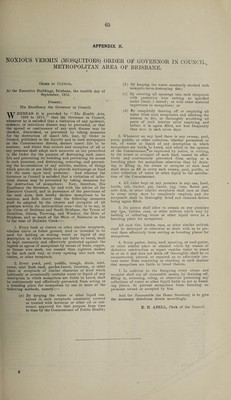
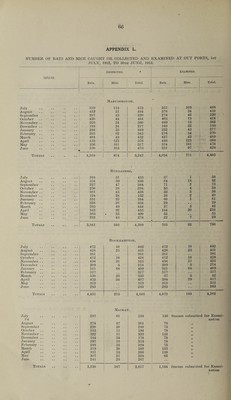
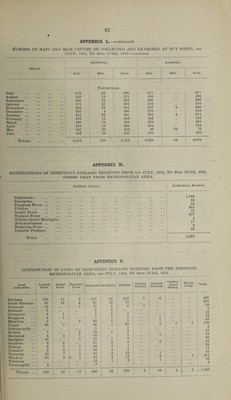
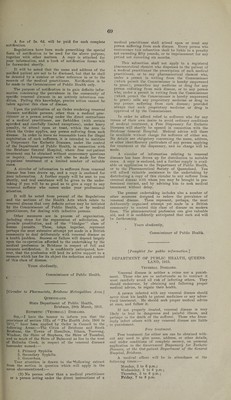
Annual report of the Commissioner of Public Health / Queensland.
- Queensland. Department of Public Health
- Date:
- [1913]
Licence: Public Domain Mark
Credit: Annual report of the Commissioner of Public Health / Queensland. Source: Wellcome Collection.
102/102 (page 70)
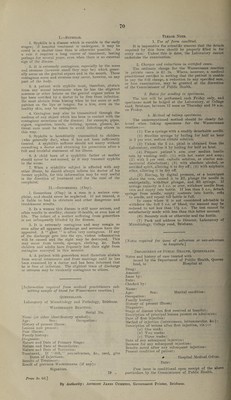
![I.—Syphilis. 1. Syphilis is a disease which is curable in the early stages; if hospital treatment is undergone, it may be cured in a shorter time than is otherwise possible. As a rule it requires a long course of treatment, lasting perhaps for several years, even when there is no external sign of the disease. 2. It is extremely contagious, especially by the sores and erosions (however small they may be) which gener¬ ally occur on the genital organs and in the mouth. These contagious sores and erosions may occur, however, on any part of the body. 3. A patient with syphilis must, therefore, abstain from any sexual intercourse when he has the slightest soreness or other lesions on the genital organs unless he lias been certified by a doctor to be free from infection. He must abstain from kissing when he has sores or soft patches on the lips or tongue, for a kiss, even on the healthy skin, may be contagious. 4. Contagion may also be transmitted through the medium of any object which has been in contact with the contagious secretions of the disease; for example, pipes, cigars, cigarettes, towels, clothing, spoons, glasses, &c. Great care must be taken to avoid infecting others in this way. 5. Syphilis is hereditarily transmitted to children (who generally die), wrhen it has not been sufficiently treated. A syphilitic sufferer should not marry without consulting a doctor and obtaining his permission after a full and truthful statement of his illness. 6. A child born of a syphilitic father or mother should never be wet-nursed, as it may transmit syphilis to the nurse. 7. When a syphilitic subject is affected with any other illness, he should always inform his doctor of his former syphilis, for this information may be very useful in the direction of treatment and for the cure of the complaint. II.-—Gonorrhoea (Clap). 1. Gonorrhoea (Clap) in a man is a serious com¬ plaint, and should never be neglected. If not treated, it is liable to lead to stricture and other dangerous and troublesome results. 2. In a woman this disease is still more serious, and often results in sterility, chronic ill-health, or even loss of life. The infant of a mother suffering from gonorrhoea is uot infrequently blinded by the disease. 3. It is extremely contagious and may remain so even after all apparent discharge and soreness have dis¬ appeared. A “ gleet ” is often very contagious. If any of the discharge gets into the eye, violent inflammation will be caused and the sight may be destroyed. This may occur from towels, sponges, clothing, &c. Both children and adults have frquently lost their sight from contagion conveyed in this manner. 4. A patient with gonorrhoea must therefore abstain from sexual intercourse and from marriage until he has been examined by a doctor and has been informed that he is free of infection. The slightest trace of discharge or soreness may be virulently contagious to others. [Information required from medical practitioners sub¬ mitting sample of blood for Wassermann reaction.] Queensland. Laboratory of Microbiology and Pathology, Brisbane. Wassermann Reaction. Serial No. Name (or other identificatory symbol) : Age: Sex: Occupation: History of present illness: Lesions now present: Past illness: Family history: Diagnosis: Nature and Date of Primary Stage: Nature and Date of Secondaries: Nature and Date of Tertiaries: Treatment. If ‘: 606,” neo-salvarsan, &c., used, give Dates of Injections: Results of Treatment: Result of previous Wassermanns (if any) : Signature. Please Note. 1. Use of form essential. It is imperative for scientific reasons that the details required by this form should be properly filled in for every case. Unless this is done, the Laboratory cannot undertake the examination. 2. Charges and reductions in certified cases. The ordinary charge for the Wassermann reaction in private cases is £2 2s. Where, however, a medical practitioner certifies in writing that the patient is unable to pay the full charge, a reduction to any specified sum, or free examination, may be granted at the discretion of the Commissioner of Public Health. 3. Dates for sending in specimens. The test will be performed each Friday only, and specimens must be lodged at the Laboratory, at College road, Brisbane, between 12 noon on Thursday and 10 a.m. on Friday. 4. Method of taking specimens. The undermentioned method should be closely fol¬ lowed when taking specimens for the Wassermann reaction:— (1) Use a syringe with a readily detachable needle. (2) Sterilise syringe by boiling for half an hour in 2 per cent, sodium citrate solution. (3) Unless the 5 c.c. phial is obtained from the Laboratory, sterilise it by boiling for half an hour. (4) Prepare patient’s arm over median basilic vein by washing well: (1) with hot water and soap; (2) with 5 per cent, carbolic solution, or similar non¬ mercurial disinfectant; (3) wdth absolute alcohol, or rectified spirit, allowing it to dry off; (4) with sulphuric ether, allowing it to dry off. (5) Having, by digital pressure, or a tourniquet above the vein, caused it to fill, plunge the needle in centripetally, withdraw plunger, and fill syringe. If syringe capacity is 5 c.c. or over, withdraw needle from vein and empty into bottle. If less than 5 c.c., detach syringe from needle, empty contents into bottle, refix to needle, and repeat till bottle is full. In cases where it is not considered advisable to withdraw the full 5 c.c. of blood, the amount may be reduced to not less than 1V2 c.c. The test cannot be satisfactorily made with less than this latter amount. (6) Securely cork or otherwise seal the bottle. (7) Pack and address to Director, Laboratory of Microbiology, College road, Brisbane. [Notes required for issue of salvarsan or neo-salvarsan to hospitals.] Department of Public Health, Queensland. Notes and history of case treated with issued by the Department of Public Health, Queens¬ land, to' ' Hospital at Drug: Amount: Issue by: Date: Checked by: Name: Age: Sex: Marital condition: Occupation: Family history: History of present illness: Diagnosis: Stage of disease when first received at hospital: Description of principal lesions present on admission: Date of first injection: Method of injection (intravenous, intramuscular. &c.) : Description of lesions after first injection, viz.: (a) One week: (!>) Two weeks: (c) Three weeks: Date of any subsequent injection: Reasons for any subsequent injection: Results noted after any subsequent injection: Present condition of patient: 0 Hospital Medical Officer. Date: Free issue is conditional upon receipt of the above particulars by the Commissioner of Public Health, Price 3s. 6rf.] By Authority: Anthony James Gumming, Government Printer, Brisbane.](https://iiif.wellcomecollection.org/image/b31490797_0102.jp2/full/800%2C/0/default.jpg)