Annual report of the Commissioner of Public Health / Queensland.
- Queensland. Department of Public Health
- Date:
- [1913]
Licence: Public Domain Mark
Credit: Annual report of the Commissioner of Public Health / Queensland. Source: Wellcome Collection.
6/102 (page 6)
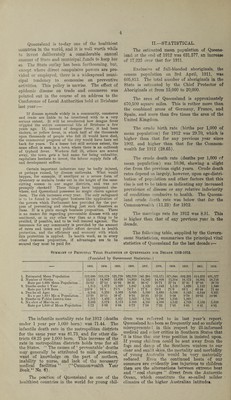
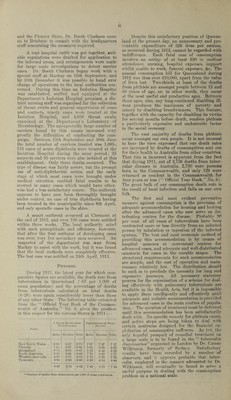
![and the Pioneer Shire, Dr. Booth Clarkson came on to Brisbane to consult with the headquarters staff concerning the measures required. A tent hospital outfit was got together, suit¬ able regulations were drafted for application to the infected areas, and arrangements were made for large scale investigations to detect carrier cases. Dr. Booth Clarkson began work with a special staff at Mackay on 15th September, and by 10th December it was possible to hand over charge of operations to the local authorities con¬ cerned. During this time an Isolation Hospital was established, staffed, and equipped at the Department’s Isolation Hospital premises, a dis¬ trict nursing staff w7as organised for the collection of throat swabs and general supervision of cases and contacts, ninety cases were treated at the Isolation Hospital, and 4,856 throat swabs examined at the Department’s Laboratory of Microbiology. The unexpectedly large number of carriers found by this means increased very greatly the difficulties of conducting the cam¬ paign. Between 15th September and 30th June the total number of carriers treated was 1,085; 124 cases of acute diphtheria were treated at the Isolation Hospital during the same period; 25 suspects and 85 carriers were also isolated at this establishment.- Only three deaths occurred. The type of disease was fairly severe, but the prompt use of anti-diphtheritic serum and the early stage at which most cases were brought under medical attention enabled fatal results to be averted in many cases which would have other¬ wise had a less satisfactory course. The outbreak appears to have now been thoroughly brought under control, no case of true diphtheria having been treated in the municipality since 8th April, and only sporadic cases in the shire. A smart outbreak occurred at Clermont at the end of 1912, and over 100 cases were notified within three weeks. The local authority acted with such promptitude and efficiency, however, that after the first outburst of developing cases was over, very few secondary ones occurred. An inspector of the department wa!s stent fromi Mackay to assist with the work, but it was found that the local methods were completely effective. The last case was notified on 24th April. 1913. Phthisis. During 1911, the latest year for which com¬ parative figures are available, the death rate from tuberculosis in Queensland (-67 per 1,000 of mean population) and the percentage of deaths from tuberculosis calculated on total deaths (6-26) were again considerably lower than those of any other State. The following table extracted from the “ Official Year Book of the Common¬ wealth of Australia,” No. 6, gives the position in this respect for the various States in 1911:— ] * Death Rates from Percent auk on Total State. Tuberculosis. Deaths Wales Females. Total. Males. Females. Total. New South Wales ... 0-85 0-67 076 7-37 7-37 7 37 Victoria 1'01 0-97 0-99 8-01 9-36 8 62 Queensland. 074 0-58 0 67 6 13 6 48 6-26 South Australia 0-81 0-91 0-86 7 75 995 i 877 Western Australia .. 0*81 071 0-78 7 18 870 770 Tasmania 0‘90 0-82 0-86 8-39 8-54 , 8’46 0-88 1 - o OC' 1 0-83 , 7-45 .8-29 - 7 80 * Xumber of deaths from tuberculosis per 1,000 of mean population. Despite this satisfactory position of Queens¬ land at the present day, an unnecessary and pre¬ ventable expenditure of 326 lives per annum, as occurred during 1912, cannot be regarded with indifference. Each fatal case of consumption involves an outlay of at least £30 in medical attendance, nursing, hospital expenses, support whilst unable to work, funeral expenses, &c. The annual consumption bill for Queensland during 1912 was thus over £10,000, apart from the value of lives lost. Two-thirds at least of the deaths from phthisis are amongst people between 15 and 50 years of age, or, in other words, they occur at the most useful and productive ages. Between these ages, also, any long-continued disabling ill¬ ness produces the maximum of poverty and misery by disabling breadwinners. This feature, together with the capacity for disabling its victim for several months before death, renders phthisis a particularly expensive and undesirable factor in the social economy. The vast majority of deaths from phthisis occur amongst our own people. It is not unusual to hear the view expressed that our death rates are increased by deaths of consumptives sent out for their health to Australia from other countries. That this is incorrect is apparent from the fact that during 1911, out of 3,736 deaths from tuber¬ cular diseases in Australia, 2,730 were persons born in the Commonwealth, and only 129 wTere returned as resident in the Commonwealth for four years or less (“ Official Year Book,” No. 6). The great bulk of our consumption death rate is the result of local infection and falls on our own folk. The first and most evident preventive measure against consumption is the provision of adequate accommodation for housing and looking after the advanced cases who now serve as dis¬ tributing centres for the disease. Probably 90 per cent, of all cases of tuberculosis have been contracted more or less directly from an infected person by inhalation or ingestion of the infected sputum. The best and most economic method of providing this accommodation is by means of hospital annexes at convenient centres for advanced cases, and adequate and well-distributed sanatoria for cases in the curable stages. The structural requirements for such accommodation are simple, and the cost of operation and main¬ tenance relatively low. The distribution should be such as to preclude the necessity for long and expensive journeys. All necessary statutory powers for the organisation of a scheme for deal¬ ing effectively with pulmonary tuberculosis are available in the Health Acts, but it is impossible to apply them intelligently and effectively until adequate and suitable accommodation is provided for advanced cases in the main centres of popula¬ tion. The question of treatment must be deferred until this accommodation has been satisfactorily dealt with. No specific remedy for phthisis exists, and active steps are being taken to deal with certain nostrums designed for the financial ex¬ ploitation of consumptive sufferers. As yet, the only hopeful prospect of remedial treatment on a large scale is to be found in the “ tuberculin dispensaries” organised in London by Dr. Camae Wilkinson, formerly of Sydney. Satisfactory results have been recorded by a number of observers, and it appears probable that tuber¬ culin, employed in the manner advocated by Dr. Wilkinson, will eventually be found to serve a useful purpose in dealing with the consumption problem on a national scale.](https://iiif.wellcomecollection.org/image/b31490797_0006.jp2/full/800%2C/0/default.jpg)