Annual report of the Commissioner of Public Health / Queensland.
- Queensland. Department of Public Health
- Date:
- [1913]
Licence: Public Domain Mark
Credit: Annual report of the Commissioner of Public Health / Queensland. Source: Wellcome Collection.
93/102 (page 63)
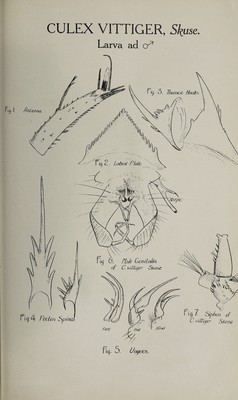
![Procumbent dorsal spine well developed; spinous dorsal originating above tlie 4th body- scale, the 3rd spine longest and strongest, a little higher than the rayed dorsal; spine of soft, dorsal 1 -35 in the height of the spinous dorsal. Anal fin originating below the 12th body scale; 3rd spine longest, as long as that of the soft dorsal, a little longer than the base of the fin and 1 -35 in the 1st ray, which is as high as that of the dorsal. Caudal fin deeply forked, the middle rays about half as long as the lobes. Third and fourth pectoral rays longest, extending to the 10th body scales. Ventral shorter than the pectoral, the two outer rays longest, reaching to the vent, the spine as long as the 3rd anal spine. “ Green above, yellowish white below; a black line which is feebly curved anteriorly from the upper angle of the opercle to the root of the caudal; the scales forming the series through which this line runs are profusely dotted with black, as also are the edges of all the scales above the line, and anteriorly the surface of the scales is similarly but more sparsely dotted, two or three series of body scales below the line and the scales of the tail with a single marginal series of black dots. Upper surface of head and nape and the opercles so profusely dotted as almost to obscure the ground colour; cheeks and lower surface of head less closely dotted. All the fins similarly marked, the dots being most crowded on the membrane of the second dorsal spine, the tips of the anterior anal rays, and the middle ventral rays. ’ ’ This is another pretty little fish found in lakes, ponds, and creeks in the neighbourhood of Brisbane. They have been found in isolated puddles—caused by soakage—not containing more than 300 gallons of water. As a rule, it does not grow to more than l-§ inches. This fish is also an active destroyer of mosquito larvae. Carassiops compressus, Krefft. (Carp Gudgeon). See remarks under Krefftius adspersus. Krefftius adspersus, Castelnau. (Purple Spotted Trout Gudgeon). Distribution: Eastern Australia. This species may be looked upon as ranging from the Fitzroy River in the North to the Upper Shoalhaven district in the South. Though the “ Carp ” and the “ Trout ” Gudgeons will eat larvae when deprived of their food for two or three days, nevertheless they do not seem to exercise any check upon mosquito¬ breeding under natural conditions. They are bottom feeders practically, lying concealed in the mud all day and only eating mosquito larva? when no other food is available. These fishes devour the fins of other small fishes, and consequently they are not of much practical use as larva-destroyers. Pseudomugil signifer (Blue-eye). This species never grows to more than li to 2 inches long. It is destined in the future to play an important part in the reduction of mos¬ quitoes on salt marshes, to which it appears to be admirably adapted. The “ Blue-eye” is sprightly, vivacious, and an active swimmer, being in addition very tenacious of life. It occurs on the coast or Queensland from the rivers of South Queensland to the New South Wales coastline, It adapts itself both to fresh and salt water, and it thrives well in confinement when once acclimatised. I have kept these fish in about 2 gallons of fresh water as long as six months. The presence of P. signifer in any salt swamp is, however, not always indicative of the absence of mosquito larva*. Numerous puddles, though isolated from the main swamp, are invari¬ ably present in these marshes. Besides these, there is usually an abundant supply of vegetation, which protects the mosquito larva? from attack. It thus becomes of prime importance to keep salt swamps deepened and cleared of rank vegetation so as to make them inhabitable for fteh. L. E. COOLING, Assistant Inspector in Charge of Mosquito Operations. Biology of Colicada Vittiger, Skuse. Cidex vittiger, Skuse (1889). [Hitherto, the ^ and life history of Culicada vittiger have not been observed.] Larva.—The full-grown larva of C. vittiger measures 10 m.m. in length, exclusive of caudal bristles. The colour is dark grey on the thorax and abdomen; head siphon and anal segment dark brown. Head moderately large and light in colour. Antennae short and simple, the plume being re¬ presented by two short subplumose hairs arising from a submedian tubercle. (Fig. 1.) Brushes slightly hooked at end and combed with very fine teeth at apex. Maxillae small, numerous very stout spines and teeth. Maxillary plume con¬ sisting of numerous stout spined hairs, spines protruding from the hairs like, and somewhat the shape of, rose-thorns. The labial plate possesses about thirteen teeth on each side and a slightly larger median one; the base is sym¬ metrically crenulated as shown in Fig. 2. Labium well clothed with long stout hairs; eyes small, round, and black. Thorax rather hairy, some of the hairs arising from four distinct chitnous hooks (Fig. 3) situated two on either side. The hairs are all subplumose. The abdomen beards ha’irs similar to the thoracic ones. First abdominal segment with lateral tufts of five or six hairs and the second segment of about four hairs. Remaining seg¬ ments bearing lateral plumes of two hairs. The comb consists of 10-12 rather simple spines. The siphon has a very rough surface, its width being about 2£ in length of siphon. The pecten spines (Fig. 4) are variable in form according to the angle of vision and also m number; 23 and 20 in one specimen and 18 and 15 in another. They increase in size upwards and run for one-third the length of the siphon, which are then terminated by three or four much larger spines situated comparatively widely apait —a distance of about the length of the spine itself. The top spine of the basal set is the longest of that set and sometimes may be situated close up to the set, or at a distance of its own length from it; its position varies so much that it is this spine that makes the fourth large one. Midway between the penultimate and ante-penul¬ timate spines (large ones) a tuft of two or some¬ times three simple hairs arise,](https://iiif.wellcomecollection.org/image/b31490797_0093.jp2/full/800%2C/0/default.jpg)