Sanitary assurance : a lecture at the London Institution / by F. de Chaumont.
- De Chaumont, Francis, 1833-1888.
- Date:
- 1881
Licence: Public Domain Mark
Credit: Sanitary assurance : a lecture at the London Institution / by F. de Chaumont. Source: Wellcome Collection.
Provider: This material has been provided by The Royal College of Surgeons of England. The original may be consulted at The Royal College of Surgeons of England.
16/28 page 14
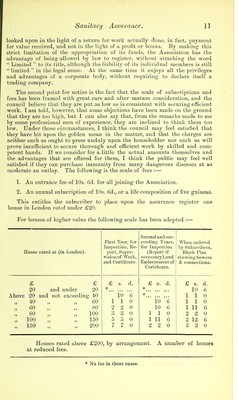
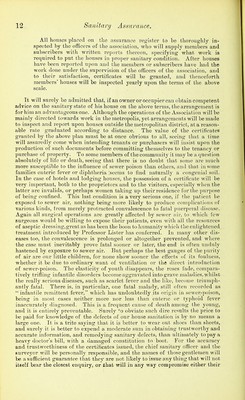
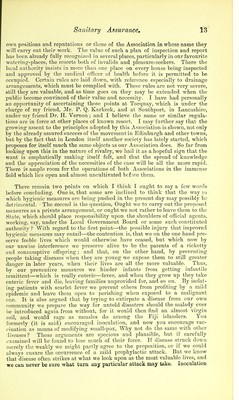
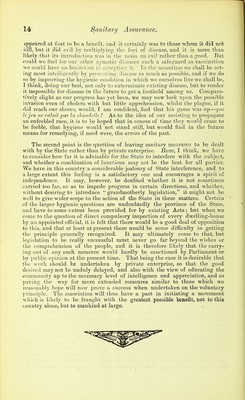
![ippeared at first to bo a benefit, and it certainly was to those whom it did not kill, but it did evil by mnltiplyiiig- the foci of disease, and it is more than likely that its introdnction was in the main an evil rather than a good. But could we find for our other zymotic diseases such a safeguard as vaccination we could have no hesitfition in iicccptiii;^- it. In the meantime we shall be act- ing most intelligently by preventing disease as much as possible, and if we do so by improving the hygienic condition in which we ourselves live we shall be, I think, doing our best, not only to exterminate existing disease, but to render it impossible for disease in the future to get a foothold among us. Compara- tively slight as our progress has yet been, we may now look upon the possible invasion even of cholera with but little appi'ehension, whilst the plague, if it did reach our shores, would, I am confident, find that his game was up—qite le jeu nevalait ims la cliandcUe ! As to the idea of our assisting to propagate an enfeebled race, it is to be hoped that in course of time they would cease to be feeble, that hygiene would not stand still, but would find in the future means for remedying, if need were, the errors of the past. The second point is the question of leaving sanitary measures to be dealt with by the State rather than by private enterprise. Here, I think, wc have to consider how far it is advisable for the State to interfere with the subject, and whether a combination of functions may not be the best for all parties. We have in this country a considerable jealousy of State interference, and to a large extent this feeling is a satisfactory one and encourages a spirit of independence. It may, howevei', be doubted whether it is not sometimes carried too far, so as to impede progress in certain directions, and whether, without desiring to inti'oduce grandmotherly legislation, it might not bo well to give wider scope to the action of the State in these matters. Certain of the larger hygienic questions are undoubtedly the province of the State, and have to some extent been provided for by existing Acts; but when we come to the question of direct compulsory inspection of every dwelling-house by an appointed official, it is felt that there would be a good deal of opposition to this, and that at least at present there would be some difficulty in getting the principle generally recognized. It may ultimately come to that, but legislation to be really successful must never go far beyond the wishes or 1 ho comprehension of the people, and it is therefore likely that the carry- ing out of any such measure would hardly be sanctioned by Parliament or by public opinion at the present time. That being the case it is desirable that the work should be undertaken by private enterprise, so that the good desired may not be unduly delayed, and also with the view of educating the community up to the necessary level of intelligence and appreciation, and so paving the way for more extended measures similar to those which we reasonably hope will now prove a success when undertaken on the voluntary princi]ilc. The association will thus have a part in initiating a movement wliich is likely to be fraught with the greatest possible benefit, not to this country alone, but to mankind at large.](https://iiif.wellcomecollection.org/image/b22278655_0016.jp2/full/800%2C/0/default.jpg)