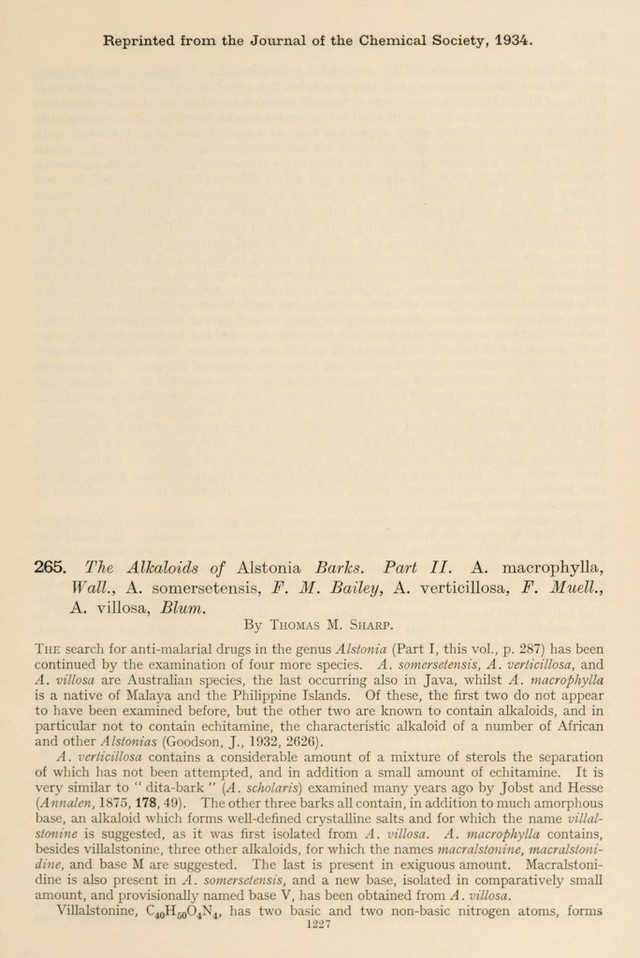
The alkaloids of Alstonia barks. Pt. 2, A. macrophylla, Wall; A. somersetensis, F.M. Bailey; A. verticillosa, F. Muell; A. villosa, Blum / by T.M. Sharp.
- Sharp, Thomas Marvel.
- Date:
- [1934]
Licence: Public Domain Mark
Credit: The alkaloids of Alstonia barks. Pt. 2, A. macrophylla, Wall; A. somersetensis, F.M. Bailey; A. verticillosa, F. Muell; A. villosa, Blum / by T.M. Sharp. Source: Wellcome Collection.
6/12 page 1230
![air-dried, and then extracted with industrial methylated spirit. The petroleum extract on evaporation left a yellowish elastic mass (228-5 g.) which was partly soluble in alcohol; the residue from this extraction was grey and of a rubbery consistency, with physical properties very similar to those of Hesse’s echikautschin (loc. cit.), although not necessarily identical with it. The alcoholic solution deposited colourless crystals which were obviously mixtures and gave colorations characteristic of sterols with Liebermann’s reagent. No further attempt at purification was made. One crop of crystals appeared homogeneous and had the same m. p. as lupeol, but a mixed m. p. showed a depression of about 40°. The methylated spirit extract was evaporated to dryness, the residue treated with sufficient 0-25% sulphuric acid to remove the alkaloid, and the acid liquor extracted with ether. It was then treated with 25% sodium hydroxide solution and shaken with chloroform. From this solution, the crude alkaloid was obtained as sulphate by extraction with iV-sulphuric acid and evaporation to dryness (yield 9-12 g.). This contained a little alkaloid which could be liberated from its salts by sodium carbonate; it was, therefore, dissolved in water, made alkaline with sodium carbonate, and extracted with chloroform. This gave 0-6 g. of dark-coloured varnish, from which nothing crystalline could be obtained and which corresponds with Jobst and Hesse’s ditamine from A. scholaris. The aqueous liquor was then treated with sodium hydroxide and chloroform, the chloroform concentrated to a small volume, mixed with alcohol, and acidified to methyl-red with 10% hydrochloric acid. Almost at once, the solution gave a crystalline crop of echitamine hydrochloride (4-7 g.). Villalstonine.—The gxalate was purified by crystallisation from alcohol, separating in colourless leaflets, m. p. 235° * (decomp.). The salt from A. villosa had [a]D -f 31-2°, that from A. macrophylla [a]D + 32-1° {c = 0-56 in acetone), f [a]D + 55-6° (c = 0-5 in water) [Found, on dried material, (a) from A. macrophylla : C, 67-8, 67-7; H, 6-95, 6-9; N, 7-8, 7-7; OMe, 4-2; NMe, 6-3; (b) from A. villosa : C, 67-8, 67-8; H, 7*1, 7-0; N, 7-6, 7-7; OMe, 4-2; NMe, 6-4. C40H50O4N4,C2H2O4 requires C, 68-1; H, 7-1; N, 7-6; OMe, 4-2; 2NMe, 7-8%]. The hydro¬ chloride, prepared by the addition of freshly prepared alcoholic hydrogen chloride to dry alcoholic solution of the base, formed colourless needles, m. p. 270° (decomp.), [a]D + 56-3° from A. villosa, + 56-1° from A. somersetensis (c = 0-5 in water) (Found : loss at 120° in a vacuum, 9*8. C40H50O4N4,2HCl,4H2O requires 4HaO, 9-1. Found, on dried salt: C, 66-2, 66-2; H, 7-4, 7- 35; N, 7-5, 7-5; Cl, 9-7, 9-7; OMe, 4-2, 4-5; NMe, 6-9, 8-1. C40H50O4N4,2HCl requires C, 66-4; H, 7-25; N, 7-75; Cl, 9-8; OMe, 4-3; 2NMe, 8-0%). The dried salt rapidly absorbs moisture from the air (Found : gain on exposure to air, 10-35. Calc, for 4H20 : 10-0%). An aqueous solution of the hydrochloride or other salt of villalstonine slowly becomes pink on keeping. The sulphate does not crystallise easily. It is rather sparingly soluble in alcohol and crystallises only after concentration, forming small prismatic rods, which do not melt at 310°, [a]D + 52-94° (c = 1-02 in water) (Found : loss at 110° in a vacuum, 12-7. C40H50O4N4,H2SO4,6H2O requires 6HaO, 12-6%. Found on dry salt: C, 63-3, 63-2; H, 6-85, 6-95; N, 7-7, 7-55; S, 4-3, 4-3; OMe, 4-1, 4-1; NMe, 6-3, 6-35. C40H50O4N4,H2SO4 requires C, 64-1; H, 7-0; N, 7-5; S, 4-3; OMe, 4-1; 2NMe, 7-8%). On exposure to air the dry salt absorbs 13-4% of its weight (Calc, for 6HaO : 14-4%). The hydrohromide, prepared by pre¬ cipitation, crystallised from alcohol in colourless needles, m. p. 293° (decomp.) (Found : loss at 110° in a vacuum, 8-0. C40H50O4N4,2HBr,4H2O requires 4HaO, 8-15%. Found, on dry salt: C, 59-4, 59-5; H, 6-3, 6-3; N, 7-1, 7-0; Br, 19-2, 19-3; OMe, 4-0, 3-8; NMe, 7-3, 6-8. C40H50O4N4,2HBrrequiresC, 59-1; H,6-5; N, 6-9; Br, 19-7; OMe, 3-8; 2NMe, 7-2%). On exposure to air the dry salt absorbed 4HaO (Found : gain on exposure, 8-8. Calc. : 8-9%). The hydriodide, colourless balls of needles from methyl alcohol, m. p. 286° (decomp.), showed a tendency to become yellow on recrystallisation and failed to give satisfactory analytical figures (Found, on salt dried at 110° in a vacuum : C, 54-2; H, 5-8; N, 6-2; I, 26-7; OMe, 3-4; NMe, 5-7. C40H50O4N4,2HI requires C, 53-0; H, 5-8; N, 6-2; I, 28-0; OMe, 3-4; 2NMe, 6-4%). The base was obtained as a colourless granular powder on the addition of sodium carbonate or hydroxide to an aqueous solution of the pure hydrochloride. It was very soluble in most organic solvents and was not obtained in a crystalline condition. For analysis it was triturated with many changes of water, and dried at 100° in a vacuum. It sintered at 218° and slowly melted up to 260° [Found : C, 73-5, 73-7; H, 7-6, 7-6; N, 8-6, 8-4; OMe, 4-8, 4-6; NMe, 7-9, 8- 1; M, cryoscopic in benzene, using alumina as drying agent (Roberts and Bury, J., 1923, 123, 2037; Brown and Bury, J., 1924, 125, 2219), 657, 645, 651. C40H50O4N4 requires C, 73-8; H, 7-75; N, 8-6; OMe, 4-8; 2NMe, 8-9%; M, 650-4). The dimethiodide was prepared by * All m. p.'s are corrected. f All the rotations were done on the dry salts.](https://iiif.wellcomecollection.org/image/b30629937_0006.jp2/full/800%2C/0/default.jpg)