[Report 1911] / Medical Officer of Health, Atherton U.D.C.
- Atherton (England). Urban District Council.
- Date:
- 1911
Licence: Attribution 4.0 International (CC BY 4.0)
Credit: [Report 1911] / Medical Officer of Health, Atherton U.D.C. Source: Wellcome Collection.
2/14 page 2
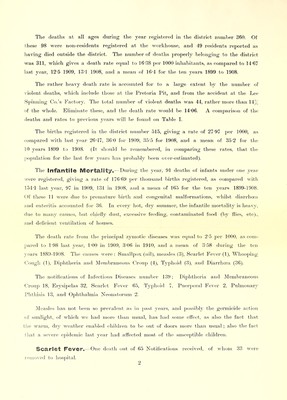
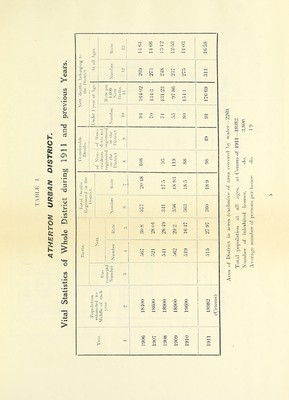
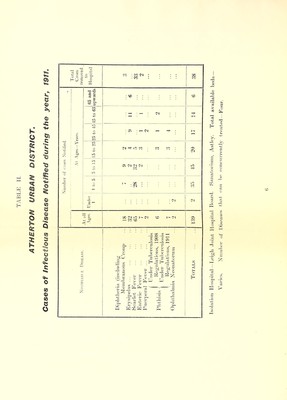
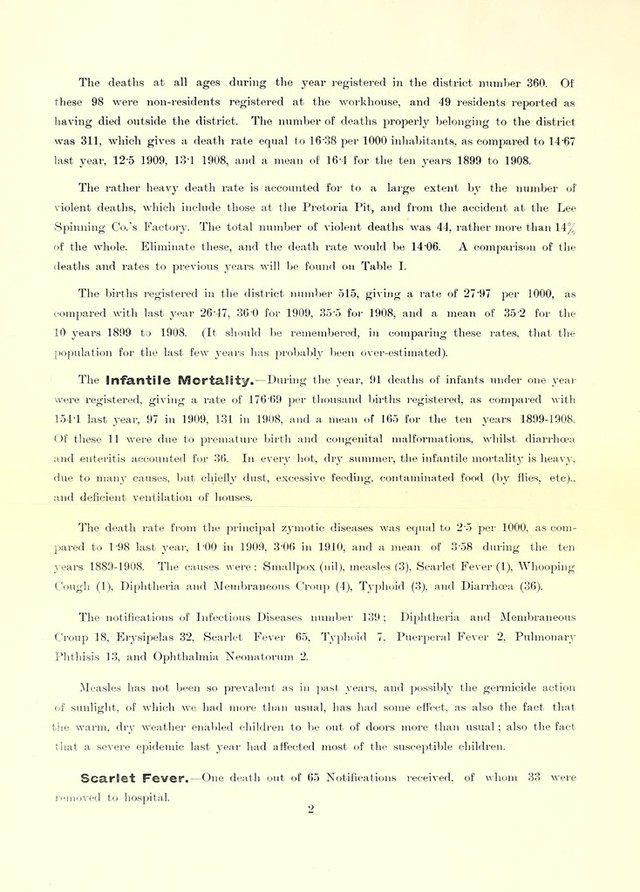
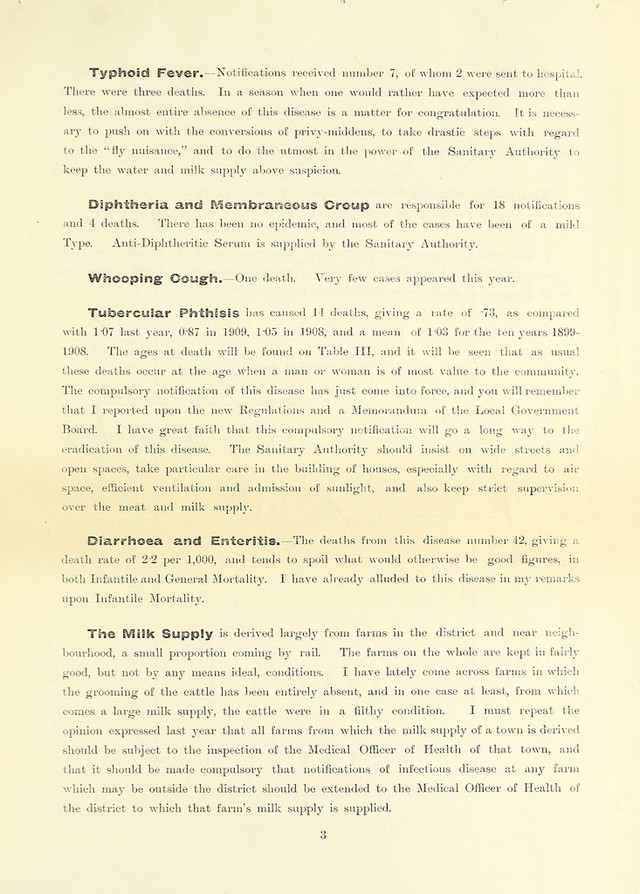
![these 98 were non-i-esidents registered at the workhouse, and 49 residents reported as having died outside the district. Idie nund)er of deaths properly belonging to the district was 311, which gives a death rate equal to 16'38 per 1000 inhahitauts, as comj^ared to 14'67 last year, 12’5 1909, lod 1908, and a mean of 16'1 for the ten years 1899 to 1908. Tlie rather heavy death I’ate is accounted for to a large extent by the number of violent deaths, which include those at the Pretoria Pit, and from the accident at the Lee .Spinning Co.'s Factory. The total number of violent deaths was 44, rather more than 14% of the whole. Eliminate these, and the death rate would be 14'06. A comparison of the deaths and rates to pi-evious years will be found on Table I. The l)irths registei’ed in the disti-ict number 515, gi\ing a rate of 27'97 per 1000, as compared Avith last year 26'47, 36 0 for 1909, 35'5 for 1908, and a mean of 35 2 for the !0 years 1899 to 1908. (It should be remembered, in comparing these rates, that the poj)idation for the last few yeai-s has ])rol)ably been over-estimated). The Infantile Mortality.—During the year, 91 deaths of infants under one yeai- u'ere regi.stered, giving a rate of 176'69 per thousand lui-ths registered, as compared with 151T last year, 97 in 1909, 131 in 1908, and a mean of 165 for the ten years 1899-1908. ()f these 11 Avere due to premature birth and congenital malformations, A\diil.st diarrhoea and enteritis accounted for 3(5. In every hot, dry summer, the infantile mortality is heavy, due to many causes, but chielly dust, excessiA’e feeding, cont.aminated food (by flies, etc)., and deficient A’entilation of hou.ses. The death rate from the principal zymotic diseases was equal to 2 5 per 1000, as com- pared to 1'98 last year, POO in 1909, 3'06 in 1910, and a mean of 3'58 dming the teii years 1889-1908. The causes were: Sm.allpox (nil), measles (3), Scarlet Fever (1), Whooping Cougli (1), Diphtheria and Dlembraneons Croup (4), Typhoid (3), and Diarrhoea (36). The notiiieations of Litectious Diseases number 139 ; Diphtheria and Membraneous Croup 18, Erysipelas 32, Scailet Fevei- 65, 4’yphoi(l 7, Puer])eral Fever 2, Pulmonary TMithisis 13, and Ojflithalmia Neonatorum 2. (Measles has not been sf) prevalent as in ])a.st years, and possibly the germicide action (>t sunlight, of Avhich AA^e ha<l more than usual, has had some eflect, as also the fact that the Avarm, diy AA'eather enabled children to be out of doors more than usual ; also the fact ■ hat a severe e2>idemic last j-ear had affected most of the .susceptible children. Sca.riet Fever. — One death out of 65 Notiiieations received, of Avhom 33 Avere rtmioved to hospital. •>](https://iiif.wellcomecollection.org/image/b28814678_0004.jp2/full/800%2C/0/default.jpg)