Volume 1
The Scottish nation, or, The surnames, families, literature, honours, and biographical history of the people of Scotland / by William Anderson.
- Date:
- 1863
Licence: Public Domain Mark
Credit: The Scottish nation, or, The surnames, families, literature, honours, and biographical history of the people of Scotland / by William Anderson. Source: Wellcome Collection.
Provider: This material has been provided by the Royal College of Physicians of Edinburgh. The original may be consulted at the Royal College of Physicians of Edinburgh.
20/798 (page 2)
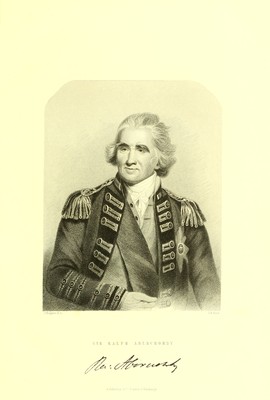
![Abercromby, born in 1838, became third baron. See Aber- CROMBY, Sir Ralph. ABERCROMBIE, John, M.D., an eminent physician, and moral and religious writer, was born in Aberdeen, 12tli October, 1780. His father was minister of the East church of that city. After having completed his literary edu- cation in his native city, he Avas sent to the uni- versity of Edinburgh, to prosecute his studies for the medical profession. Tiie celebrated Dr. Alex- ander Munro was at that time professor of anatomy and surgery tliere, and the subject of this memoir attended his lectures. In 1803, being then twenty-three years of age, Dr. Abercrombie began to practise as a physician in Edinburgh. He soon acquired a high reputa- tion, and became extensively known to his pro- fessional brethren through the medium of his con- tributions to the ' Medical and Surgical Journal.' On the death of the celebrated Dr. Gregory, in 1821, Dr. Abercrombie at once took his place as a consulting physician. He was also named physi- cian to the king for Scotland, an appointment which, though merely honorary and nominal, is usually confeiTed on the physician of greatest eminence at the time of a vacancy. He subse- quently held, till his death, the office of phy- sician to George Heriot's Hospital. In 1828, he published a treatise on the ' Diseases of the Brain and Nervous System,' and soon after an essay on those of the ' Abdominal Organs,' both of which rank high among professional publica- tions. In 1830 he appeared as an author in a branch of literatm-e entirely different, and one in- volving the treatment of subjects in the highest department of philosophy and metaphysical specu- lation, having published in that year his able work, in 8vo, on the 'Intellectual Powers.' In 1833 he produced a work of a similar kind, on ' The Philosophy of the Moral Feelings,' also in 8vo. In 1832, during the prevalence of the cho- lera, he had piiblished a medical tract entitled ' Suggestions on the Character and Treatment of Malignant Cholera.' In 1834 he published a pamphlet entitled ' Obseiwations on the Moral Condition of the Lower Orders in Edinburgh.' The same year appeared an address delivered by him at the Fiftieth Anniversary of the Destitute Sick Society, Edinburgh. He was also the au- thor of Essays on the ' Elements of Sacred Truth,' and on the 'Harmony of Christian Faith and Character;' besides other writings which have been comprised in a small volume entitled 'Essays and Tracts.' Of writings so well known, and so very highly esteemed, as proved by a circulation extending, as it did in some, even to an eighteenth edition, it were useless to speak in praise either of their literary or far higher merits. But, distin- guished as he was, both professionally and as a writer in the highest departments of philosophy, it was not exclusively to his great fame in either respect, or in both, that he owed his wide influ- ence throughout the community in which he lived. His name ever stood associated with the guidance of every important enterprise, whether religious or benevolent,—somehow he provided leisure to bestow the patronage of his attendance and his deliberative wisdom on many of the institutions of Edinburgh, and, with a munificence which has been rarely equalled, ministered of his substance to the upholding of them all. He valued money so little, that he often declined to receive it, even when the offerer urged it, as most justly his own His diligence and application were so great that whoever entered his study found him intent at work. Did they see him travelling in his carriage, they could perceive he was busy there. [^Obituary notice in Witness newspaper.'] In 1834 the university of Oxford conferred upon him the degree of M.D., which he had long previ- ously obtained from the university of Edinburgh. In 1835 he was chosen by the students lord rector of Marischal college, Aberdeen. Dr. Abercrom- bie died suddenly at Edinburgh, from rupture of an artery in the region of the heart, on the 14th of November, 1844. Distinguished alike as a physician, an author, a benefactor of the poor, and a sincere Christian, his loss was universally lamented. He was buried in the West church- yard, Edinburgh, where a monument with a me- dallion has been erected to his memory, the for- mer bearing the following inscription:— In mem- ory of John Abercrombie, M.D., Edin. and Oxon., Fellow of the Royal colleges of Pliysicians and Surgeons, Edinburgh, Vice-president of the Royal Society of Edinburgh, and first Physician to the](https://iiif.wellcomecollection.org/image/b21974354_0001_0020.jp2/full/800%2C/0/default.jpg)