Volume 2
The Scottish nation, or, The surnames, families, literature, honours, and biographical history of the people of Scotland / by William Anderson.
- Date:
- 1863
Licence: Public Domain Mark
Credit: The Scottish nation, or, The surnames, families, literature, honours, and biographical history of the people of Scotland / by William Anderson. Source: Wellcome Collection.
Provider: This material has been provided by the Royal College of Physicians of Edinburgh. The original may be consulted at the Royal College of Physicians of Edinburgh.
24/784
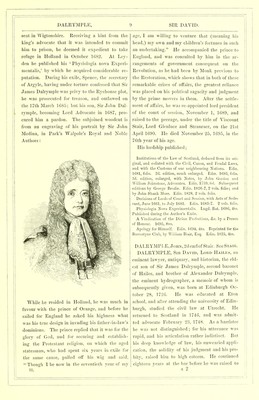
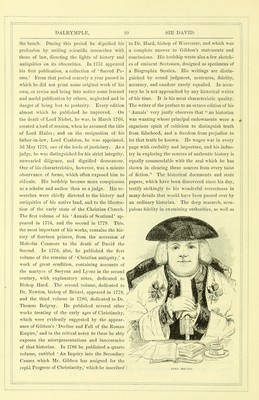
![Valery. He was taken pr'soncr by tlie French, and remained some time in captivity in France. He became a commander in 1814, and in 1820 married a daugliter of Antony Teiriera Sampayo, Esq. of Peterborough House, Fulham, by whom he liad issue. In 1852 he was appointed a deputy-lieutenant of Linlithgowshire, and is in receipt of a pension for the wounds which lie received duiing the war. DALYELL, Sir Tiiom.\s, of Binns, in West Lothian, an eminent Cavalier oflScer, was born there about 1599. He was the son of Thomas Dalyell of Binns, by his wife the Hon. Janet Bruce, daughter of the first Lord Bruce of Kin- loss. He early entered the army, and on the breaking out of the civil wars he fought bravely for the king. He had at one time the command of the town and garrison of Carrickfergus, where he was taken prisoner by the rebels. After the execution of Charles the First, he never shaved his beard, which grew white and bushy, and de- scended almost to his girdle. He adhered to the fortunes of Charles the Second with the utmost fidelity, and at the battle of Worcester, in 1651, he had the rank of major-general, but being again taken prisoner, he was committed to the Tower, his estates forfeited, and himself excepted from the general act of indemnity. Having succeeded in escaping from the Tower, he seems to have gone abroad. Li 16bi he landed with some royalists in the north of Scotland, and, supported by a small party, took possession of the castle of Skelko. He assisted in the exertions then made for the restoration of Charles, who soon af- ter sent him the following testimony of his appro- bation : Tom Dalyki.l, Though I need say nothing to you by this honest bearer. Captain Mewes, who can well tell you all I would have said, yett I am willing to give it you under my owne hand, that I am very much pleased to hcare how constant 3'ou are in your affection to me, and in your endeavours to advance my service. We have all a hardc work to do: yett I doubt not God will cany us through it: and you can never doubt that I will foi'gett the good part you have acted; which, trust me, shall be rewarded, whenever it shall be in the power of your affectionat frind. CoLEN, 30 Der. 1054. Charles H. When the affivirs of Charles became desperate in Scotland, Dalyell, provided with several strong recommendations from that prince, for eminent courage and fidelitj-, went to Russia, and entered the Muscovite service, when the Czar, Alexis Michaelowitch, made him a general. He displayed much bravery in the wars with the Turks and Tar- tars, and after some years' active employment, he requested permission to return to Scotland, where- upon the Czar ordered a flattering testimony of his sendees to pass under the great seal of Russia. In 1665 he returned to Scotland, and in the year following, Charles the Second appointed him commander-in-chief of his forces in that kingdom. He was also created a piivy councillor, and after- wards elected a member of parliament for the county of Linlithgow. On the 28tli of November 1666, he suppressed the rising at Pentland, and his memory is still execrated for his ciuel perse- cution of tlie Covenanters. In the same year he raised a regiment of foot, but its place in the military lists is not now known. He was not at Bothwell Bridge; his commission as commander-in-chief in Scotland having been in- tennitted for a fortnight in June 1679, and be- stowed on the duke of Monmouth; in consequence of which General Dalyell resigned all his employ- ments, but was immediately restored to them, and received an ample pension besides. He had re- ceived the gift of the forfeited estate of Muir of Caldwell, in lieu of large sums which he had ex- pended for the king. At the Revolution, all the forfeited estates were restored to their right owners, and the General's family never obtained any indemnification for a claim exceeding one hundred thousand pounds against Government, except an inconsiderable pension, \_rianfaii's British Family Antiquity^ 8th vol. app. p. ccxxxi. Note.'] In 1681 he raised the regiment which has since so often distinguished itself under the name of the Scots Greys. It was formerly the custom for the younger sons of reputable families to serve in that regiment as volunteers, whence the opinion long prevailed that at one time the whole regiment consisted of gentlemen onlj'. The letters of ser- vice for raising the Greys are dated the 25th November 1681. He generally went to London once or twice a-year to kiss the king's hand, and the eccentricity of his dress and appearance drew](https://iiif.wellcomecollection.org/image/b21974354_0002_0026.jp2/full/800%2C/0/default.jpg)