Volume 2
The Scottish nation, or, The surnames, families, literature, honours, and biographical history of the people of Scotland / by William Anderson.
- Date:
- 1863
Licence: Public Domain Mark
Credit: The Scottish nation, or, The surnames, families, literature, honours, and biographical history of the people of Scotland / by William Anderson. Source: Wellcome Collection.
Provider: This material has been provided by the Royal College of Physicians of Edinburgh. The original may be consulted at the Royal College of Physicians of Edinburgh.
33/784
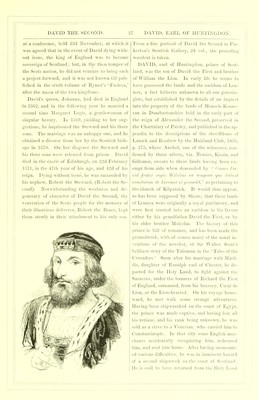
![long dccliuing, gave waj', and lie Avas found dead in his bed at Carlisle, in an attitude of jiiayer, Jlay 24, llo.J. Tlie cliaracter of this ])iou.s and jiatriutie nion- arcii stands out in histury as lliat of one of tlie wisest and best of the kings of Seotland. Under Ids benefieent sway, the conntiy was eoutented and hajijiy. The endowments whit ii he bestowed upon the ehurcli produced immediate and benefi- cial elVeets upon tlic nation, for to tlie inlluence of the clergy may lie mainly attiilmtccl iioi only the l)roniotion of knowledge and of the ai ts of indus- try among tlie peojjle, but the loyalty- and love of order of the barons, at that time for the most part a simpler race, new to their dignities, and more under the persuasive influence of the clergy than iu later periods of Scottisli history, when, tlieir families having multiplied and become powerful, they vexed the kingdom by their ambition and rivalries. Besides Edinburgh and St. Andrews, the towns of Brechin, Montrose, Haddington, Linlithgow, Jedbmgli, and Ilutbergleu owe their charters of buighal rights to the wisdom of David tlio First. His seal as count of Cumbria has bceu already given (vol. i. p. b3.) In one of the charters of liis graudsou JIaleolm, who succeeded him as king, is a reiircsentatiou of an old and a young man, generally snpjiosed to represent these two monaiclis from which the preceding as his portrait has been taken. Ill a work njioii .Scuttisli biograjiliy the circum- stance of the settlement in Scotland of the aiices- toi-s of most of the families who, even to modern times, arc reckoned of note in that country, having occurred during tiie reign of this great jiriuce, mii.-t not be omitted. To eiiuiiierate even the names of the luincijial of these would exceed our present limits. Originally located, for by far the gi-eate.-t jiart, ou lands in his priiieipalit\- of Cuiiibiia, (the modern Lolliians, and Ayrshire,) which their prow- ess had probably contributed to conquer, these chiefs, for the most jiart of Norman descent, gra- dually c.Kteuded themselves by marriage, or by coufiscatiou of the native possessions, into and over tiie northern portion of the kingdom ; and holding them by tenures which necessarily called forth and strengthened their militaiy spirit, and with regalities and rights more ample tiian could be obtained from the neighbouring monarchy of England, they became the firm advocates of the integrity of the kingdom, w hilst their descendants iu subsequent ages having greatly multi])lied, and forming the majority of the inhabitants of these regions, gradually gave an entirely new aspect to the social character of the iifipiilation. DAVID THE SECOND, king of Scots, son of llobcrt the Bruce, succeeded his father, 7tli June 1329, when little more than five years old, having been born at Duuferinline, 5th March 1323-4. On the Mill November 11531, he was crowned at Scone, with his consort, Johanna, daughter of Edward the Second, whom, child as he was, he had married at Berwick, on 12th July 1328, in virtue of the treaty of Northampton, which had restored peace between Scotland and PZnghind. After the success of Edward Baliol and the disin- herited barons, ou then- invasion of Scotland in September 1332, the disgraceful surprise of Dup- plin, and the more fatal battle of Ilalidon Hill in 1333, David and iiis infant queen werf, for greater security, sent to France, where they remained till Baliol had been driven out of Scotland, and his adherents di.spersed. In 1.340, the young king of .Scots wjis with the Fimeh army under Philip of](https://iiif.wellcomecollection.org/image/b21974354_0002_0035.jp2/full/800%2C/0/default.jpg)