General French and English dictionary, newly composed from the French dictionaries of the French Academy ... / from the English dictionaries of Johnson, Webster ... etc.
- Alexander Spiers
- Date:
- 1849
Licence: Public Domain Mark
Credit: General French and English dictionary, newly composed from the French dictionaries of the French Academy ... / from the English dictionaries of Johnson, Webster ... etc. Source: Wellcome Collection.
543/640 page 525
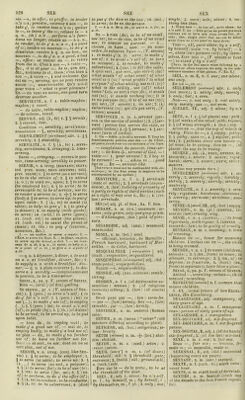
![SE N a. o.'s meaning; être de bon —, (th.)to be sensible; to be =; être dans son bon —, to be in o.’s =s, in o.'s right =s, in o.'s wits ; n’ètre pas dans son bon — , to be out of o.’s —s, mind; être brouille avec le bon —, to hâve no = ; être hors de son bon —, to be out of 0. ’s =s, mind; être — dessus dessous, 1. to be topsy-turvy; 2 to lie y/ topsy- turvy ; mettre q. u. hors de son bon —, to craze a. o.’s unis ; ( lo drive y/ a. 0. ou lof his =s , mind, wits; mettre — dessus dessous, ||$ 1. to turn upside down; 2. to turn topsy-turvy ; se mettre — dessus dessous, totarn upside down; parler bon — , to talk = ; to talk sen- sibly; parler dans le meme — (que), to express the same sentiments (as); ( to chime in (with): perdre les —, to be- come \J, to be taken senselcss ; privé de oOn bon — , out of o. 's =s, mind; re- prendre ses — , to recover o.’s —s; to corne y/ to o.’s =s; to corne y/ to o.’s self again ; to corne yf to ; tomber sous le — , les —, (ih.) 1. J to be obvions to the =s; to be palpable ; U. § to be obvious. Le simple bon — le veut ainsi, it stands to reason. Qui a rapport aux—, sensual. SENSATION [sançâcion] n. f. sensation. Causer, faire éprouver, occasionner une —, to cause, to occasion a =; éprouver une —, to experienre, to feel y/ a =; faire —, 1. || to cause, to occasion a 2. $ lo make y/ a =, quite a =. SENSÉ, E, adj. 1. (pers) sensible; intelligent; ofsense; 2. (th.) sensible (conformable to reason). SENSÉMENT, adv. sensibly ; with sense. SENSIBILITÉ, n. f. (À, to) 1. fl sensi- bihty ( susceptibility of impression); 2. J sensibility (acuteness of sensation) ; 3. U ( of flesh) tenderness ; soreness; S. Ssensibility (moral); sensiliveness; im- pressibility ; 5. S sensibility : feeling ; tenderness ; lender - heartedness ; 6. (phys.) (of balances, thermometers.&c.) sensibility. Vive — , (g. s.) (pers.) sentimenta- lity. Avec —, (V. senses) tenderly. Avoir une grande, une profonde — , io be very sensitive; être d’une grande — (à!, i.(pers.) lobe very sensible (of) ; lo be sensitive (to): 2. (th.) to be very sensitive (to); 3. (of flesh) to be very tender. SENSIBLE, adj. 1. J S (À, of) sensible (receiving impressions); 2 H § (À, to) sensible ( making an impression on the senses); 3 ||obutouj; sensible ; 4. (of flesh) tender: sore; 5. $ sensitive (easily affeetedl; feeling; impressible ; tender- hearted; 6. (of the horizon) visible : 7. (did.) sentient : 8. (ined.) tender; sore; 9. (mus.) sensible: 10. (phys.) (of ba- lances, thermometers) sensible. Fort, vivement —, (pers.) (g. s.) sen- timental. Endroit, partie —, tender, sensiti ve part ; note —, (mus.) sensible note; personne fort, vivement—,(g. s.) sentimenlalist. D’une manière — , 1. || 5 sensibly;2 $ sensitively: feelingly. Être — à, (pers.) to be sensible of ; rendre — (à la douleur), l.J tomake, to render sore, tender; 2. $fo ma/ce, to render sore. SENSIBLE , n. f. (mus.) sensible noie. SENSIBLEMENT, adv. 1. || $ sensibly (perceptibly) ; 2. fl $ obviously; 3. S sen- sibly; greally; much. SENSIBLERIE, n. f. (b. s.) sentimen- tality. Plein de — , sensibilitous. SENSITI-F, VE, adj. (did.) sensitive ; sentient. Être—.(d\d.) sentient being; sentient. SENSITIVE, n. f. (bot.) 1. sensitive- plant ; 2 humble-plant. SENSOR1UM («insoriomm] n. m. (did.) «rworium. SEN SENSUALITÉ, n. f. 1. sensuality ; 2. —s, (pi.)sensual pleasures, pl. SENSUEL, LE, adj. sensual (volup- tuous). Rendre — , to sensualize. SENSUEL, n. m. LE, n. f. sensualisl. SENSUELLEMENT [sansuélman] adv. sensually. SENTE , n. f. t \. Sentier. SENTENCE, n. f. I. sentence; maxim; 2. sentence ; judgment ; de créé ; 3. ( sentence (of death); 4. $ (law) sen- tence (of an inferior tribunal). Prononcer une —, to sentence; to pass sentence. Dont la — n’est pas pro- noncée, unsentenced. SENTENC1ER, v. a. + (crim. law) to sentence. SENTENCIEUSEMENT [santancieùzman] adv. (b. s.) senlcntiously. SENTENC1EU-X [saniancieù] SE, adj. (b. s.) sententious. Caractère —, sententiousness. SENTENE, n. f. thread of askein; thread. SENTEUR, n. f. 1.1 scent ; odour ; fragrance ; 2. scent ; per fume. Boite de —, scent-box SENTIER, n. m. 1.1| pat h ; path-way; foot-palh; foot-way; 2. § pal h ; track. — battu, bealcn pat h; beaten track ; — détourné, by-= ; — épineux S. brake. SENTIMENT, n. ni. 1. || sensation ; feeling; 2 || § perception ; feeling; 3. || feeling (faculty); 4. || consciousness ; sense; 5. sensibility (physical); ( feel- ing ; 6. $ sensibility (moral); feeling; sentimentality; 7. S sentiment; feeling; 8. § opinion, sing. ; ( sentiments , pl. ; 9. t S resentmeni. Bon —, ( V. senses) $ good, proper, right feeling; — intérieur, t. self- consciousness ; 2. S internai = ; mau- vais — , (V. senses) xmproper, wrong =. — du bien public, public spirit. Plein de — § , sentimental. Défaut , manque de —, unconsciousness; unité de —, fellow- =. Avec —, feelingly; with —; du même — , consentient ; par — , from =; parle—, (V. senses) by good words ; selon '.e — de q u., in a. o.’s opinion; in a. o.’s mind. Animé du — du bien public, public-spirited; avoir des —s, to hâve proper senti- ments, =s; avoir le — de, to be sensi- ble of: to be , lo feel y/ conscious of ; to feel y/; n’avoir pas le — de, to be, lo feel y/ unconscious of; n’avoir point de — , to hâve no —; avoir de bons —s pour q. u., to bear y/ a. 0. good will ; avoir un — intérieur, to be self-con- scious; blesser les —s de q. u., Io hurt y/ a o.’s =s ; dire son — , fo spealc, to State o.’s opinion; to spealc y/ o.'s senti- ments; exprimer son —, to express, to spealc yf o.’s sentiments ; avoir perdu tout —, to be lost to every thing: pous- ser les beaux —s, to talk gallantry; tomber dans le — de q. u., to (ail y/ into a. o.’s opinion. SENTIMENTAL, E, adj. (b. s.) senti- mental ; sensibilitous. Personne—e, (b. s.) sentimenlalist. SF.NT1NE, n. f. 1. (nav.) well-room; well; 2 $ sink (ofvice). SENTINELLE, n. f. (mil.) I. sentinel (soldier); sentry: 2. senlry (walch). — perdue, forlorn sentinel. Etre en — . to lceep y/, to stand y/ = ; fo be on sentry; faire —, to keep y/, to stand y/ = , sentry; mettre q. u. en —, 1. || to put \J a. 0. on sentry: 2. S to put y/ a. 0. in the way of seeing what 1 s going forward; se mettre en —, to keep y/, to stand ^ sentry; relever q. u. de — S, to reproach a. 0. with the fault he lias committed. [ Sentinzli.e îr soraetimes employed in the m. by tbe pools ] SENTIR, v. a. (sentant; senti; ind. près, sens; subj. près, sente) i.||lo SfclO 625 feel y/(perceive by the touch); 2. |j to feel y/(expérience a sensation of); 3. $ to feel yt (by the soûl, mind); lo expé- rience. 4. § to feel y/(know); to be sen- sible of; to liane a sense of; 5.S to feel y/ (be movcd, affected by); 6. || tosmell y/ (pcrceive by the ollaciory nerves); 7. || (of animais) to smell y/; to scent; 8.’ S <0 foresee g; to see y/; 9. || to taste; to taste of; to hâve a taste of; to savour of ; 10. || to perceive (a taste); U. S fo savour of; ( to smack of; 12. S to hâve the nppear- ance of; to looklike; l3.(man.)fo/cc/y/ (a horse). 1.—q ch. par le» doigts, les mains, to feel a. th. with o.'s Jingcrs, hands. 2.— le froid, lo chaud, la faim, la soif, la douleur, to feel eold, hent . h'inger. thirst, pain. 3. — de la joie, de l’afflic- tion, to feel, to expérience joy, affliction. 4.— le néant des choses humaines . tu feel, robe sen- sible of, to hâve a sense of the nothingness of the things of the World ; — son ignorance , to feel o.’s ignorance. 5. —une perte, une in suite, to feel a loss, an insult. 6. — une odeur. to smell an odour 8. — un événement de loin. to foresee an event from afar. 9. Un poisson qui sent la bourbe, a fis h that tastes of the nmd; du vin qui sent lo terroir,wine that tastes of the soi/. 11. Un langngo qui sent le corps de garde. language that savours of the guard-honse. 12. Tout sent ici la richesse et le luxe . la joie et le bonheur , ail has tho appearance here of riches and luxury , of joy and happiness. — q. ch. pour q. u. S, to feel y/ affec- tion lor a. o.; ne — rien ||, t. to hâve no odour, smell; 2. to hâve no taste; — comme il faul§, to liave a due sense of; to be duly sensible of; — l’huile de lampe, to smell y/ of the lamp (be labour- ed) ; — par l’odorat, tosmell; — par le tact, to feel y/. Faire — q. ch. à q. u., ( V. senses) to impress a. o. with a sense ofa. th.; to make yla. o. sensible of a. th. ; ( lo show y/ a. o. a. th ; ( to bring y! a. th. home to a. o.; se faire —,(V. senses)(th.) î. to be perceptible; to show y/ o.'s self: 2. to tingle. Il sent le..., there is an odour, ( smell of...; je ne puis — q. u., q. ch., T cannot bear а. o., a. th. Qu’on ne sent pas, unfelt ; qu’on n’a pas senti, unfelt. Se sentir, pr. v. ( V. senses of Sen- tir) l. || § (pers.) to feel y/ o.’s self; 2. || (pers.) to feel y/ (...) ; to feel y/ the ef- fecls(of); 3. $ to feel \J (hâve a perception of); 4. § (pers.) lo know y/ o.’s self; 5. $ (pers.) (de,...) to feel y/; to expérience; б. S (pers.) lo feel y/; to be conscious; 7. S ( th-) fobe/e/I(known); to be sensible. Ne pas —, (V. senses) to be, to feel y/ unconscious ; ne pas — comme à l’or- dinaire, not to feel y/ as asual; ne pas — d’aise, de joie , to be unable to coii- tain o.’s self for joy. Qui ne se sent pas, unconscious. [Sentir must not be confounded with tâter.) SENTIR, v. n. (conj. like Sentir) i. || to feel y/ (be perceivedby the touch); 2. S lo feel y/(be rnoved, affected); 3. || to smell y/; lo hâve an odour; 4 || (b. s.) 10 smell y/; to hâve a bad odour; 5. (of animais) to smell y/. — bon, fo smell y/ good, nice, pleas- ant; — mauvais, to — bad, nas-‘.y, un- pleasant. — de ..., o.'s ... to — de la bouche, o.’s brealh to =; — des pieds, o.’s feel to =. Qui sent bon, pleasant smelling; that smells good. SEOIR [soir] v. n. f (séant; sis) to sit y/. Se seoir, pr. v. f** ( to sit y/; to sit y/ down. SEOIR [soir] v. n. irreg. (seyant; sis; ind. près, il sied; ils sient; fut. il siéra) S (à, ... ; de, to) to become y/,- to be becoming ; to suit; lo be suitable, fxtting. Il sied h q u. de faire q. eh., it becomea a. o. to do a. th. Il sied mal à q. u. de , it ill be- comes a. o. to il ne sied pas à 11 ts unbecoming, unfitting, unseemly to ... Qui sied bien, becoming; qui ne](https://iiif.wellcomecollection.org/image/b2201391x_0561.jp2/full/800%2C/0/default.jpg)