On the development of the blood and blood-vessels, being the prize essay for 1854 of the Edinburgh Harveian Society / by James Drummond, M.D.
- Drummond, James
- Date:
- [1854]
Licence: Public Domain Mark
Credit: On the development of the blood and blood-vessels, being the prize essay for 1854 of the Edinburgh Harveian Society / by James Drummond, M.D. Source: Wellcome Collection.
Provider: This material has been provided by The University of Glasgow Library. The original may be consulted at The University of Glasgow Library.
10/24 page 10
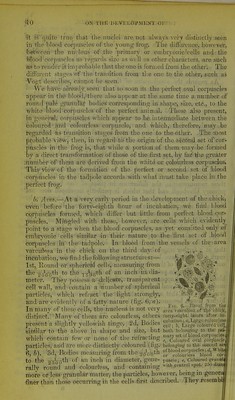
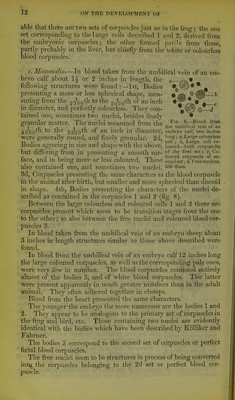
![4^0 ft ife''ciiijtie trne^ that the nucloi are npt always very distinctly seen in the blood corjuiscles of the young frog. The diffurence, however, 'between the nucleus of ,the primary or embryonic'cells and -the Wbod'corpuscles as regards size as well as other charficters, are such to-render it im])i'obiible tliat the one is formed from the other. The different stages of the transition from tlie one to the other, such as 'Vogt describes, cannot be seen. ■ We have alrefvdy, seen that sc^ soon as the perfect oval corpuscles appear in tlrC' blood/there also appear at the same time a. number of round pale grariulaf bodies corresponding in shape, size, etri., to the white blood'corpuscles'of the perfect animal. These also present, in general^ corpuscles which appear to be intermediate between the feoloured *'and cofourless corpuscle, and AVliich,'thereforey 'iiimy ,be regarded as transition stnges from the one to the other. The^most probable vig\v, then, in regard to the origin of the s«(i6nd set of cor* puscles in the fi'Og is, that while a portiort of them anay^be,formed by a direct transformation of those of the first set, by fait'tjie greater inumber of them are derived from the white or colou,iiles3 corpusclesi ■This'vieof the formation of the perfect or secolndi.set of iblood ■corpuscles in the tacljjole accords with what .must take placa in the |)erfect frog. ; • b. Av^s.—^At a very early period in the development of the clnek, leVeh' before the forty-eighth hour of incubation, we find, blood corpuscles formed, which differ but little, from perfect blood por- pnscles. Mingled with these, however, are cells which evidently point to a stage when the bU)od corpuscles, as jet consisted only lof embryonic cells similar -in their nature l:o '^lie rfirst. set df .blood corpuscles in the tadpole. In blood from the vessels-of^ thenarea varculftsa in tlie chick on tiie third day 'of ;-''..j^, e-^-.-j, ■ ''■' incubation, we- find tlie following structures':— ®/%. 1st, Eound or sphericltl cells, measuring from ^4^^:^p-*^ ' the ^o'g'Q-th to this-Y-g^jjjth of an inch'^^^^ ; V.V'^r^i-'i^^^^^^^^ metei-. They possess a-deljc»<*,- tJ^iJ^^pai-ent , ^^.!^:^S^f^i^ cell wall, and contain a number of spherical particles, which refra'ct the liglit' strongly,. and are evidently of a fattv nature (fig.'6, ■«); '^i-, Tr' '' T n ^ 111 1 1 i • i. I ll- l.^-—I'loiw from tac In many of tliese cells, the nucJeus is not very a^ca vasculosa of the'bhitk, distinct.Many of them are colourless, others I'orty-ciglit. liio«rs iiFter in- present a slightly yellowish tinge. 2d, Bodies'^^Xi^o:^ similar to the above in shape aud size, but both bolonfnuf,' to thc^ pKs= which contain few. or none of the refracting :!;''S.^^:}''^oval'S^^^^^^ particles; aiid aVe n^oi'c distinctly coloured (fig.' belongin!,' to thfe sbccna 6, b). 3d, Bodies measuring fi^m the^^,,^th ^'^^^f^^^^l to the Ti-r\7r|-th of an inch in diameter, gene- puscic; «, Coloured Rranol rally round and colourless, and containing ith.centn.i sKot.; ssodia- riiore or less granular matter, the particles, however, being in gener, finer than those occurring in the cell. first dcsci-ibed. They jesemb](https://iiif.wellcomecollection.org/image/b21477644_0010.jp2/full/800%2C/0/default.jpg)