On the development of the blood and blood-vessels, being the prize essay for 1854 of the Edinburgh Harveian Society / by James Drummond, M.D.
- Drummond, James
- Date:
- [1854]
Licence: Public Domain Mark
Credit: On the development of the blood and blood-vessels, being the prize essay for 1854 of the Edinburgh Harveian Society / by James Drummond, M.D. Source: Wellcome Collection.
Provider: This material has been provided by The University of Glasgow Library. The original may be consulted at The University of Glasgow Library.
7/24 page 7
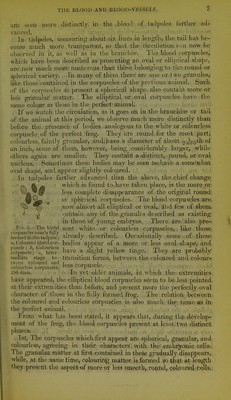
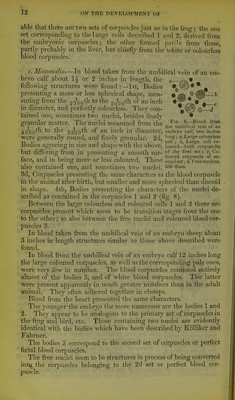
![Tllli; ULOOD AND BLOOI)-\'ii!SSf:l.S. 1. am seen more distinctly, in the yblood , oj^.,tadpoles- fartUer' ad4 vancecl. - ■ ■» ■••!•, ' '•■ ■■ ■.•?•:'<[ '•«• • In tadpoles, measuring about-six line's'.ia lengtli^.itiie tail hafs be- come much more transpaiient, so that tWMcirciilatiuji; can now, be observed in it, as well as in tlie branchifo. The blood corpuscles, which have been described as presenting an .oA'al or elliptical sliape, are now much more numerous than those belonging to t he round er spherical variety. In many of them there are one or two granules, like those contained in the corpuscles of the previous animal. Su-cb of the corpuscles as present a spherical shape ailso contai/i more or less granular matter. The elliptical or.oval corpuscles have, the same colour as those in the perfect animal. .- . : If we watch the circulation, as it goes on in the brancbise- or tail of . the animal at this period, we observe muchtaore distinctly thaii! before the. presence of bodies, analogous to the white or colourless corpuscle of the perfect frog. They are round for the most partj colourless, faintly granular, .andihave a diameter of about ijgJjf ^th of an inch, some of them, however, being considerably larger, while others again are smaller. They con'tariri a.distinctj .pund, or oval, nucleus. Sometimes these bodies may be seen t*)ohave a somewdiat oval shape, and appear slightly coloured. .i'jbi.r;i tif.i . In tadpoles farther advanced than the abbve, the. chief change which is-found to-.have taken place, is the more or . . A fi''^' less complete disappearance of the original round' ■ B^, ^. or spherical corpuscles. The blood corpuscles are, f^^-. ^now almost all elliptical' or oval,: aVid.fe.w of .them i . contain airy of; the granules described as existing •i , J . , in those of young embryos. Thei'e are I also pre- Fro. 5.—The blof),d sent white or colourless corpuscles,, like those. corpuscles nearly fully i -i ^ -i i /-^ • ii r feriiied in the tadpole ; au'cady described. Uccasionally some! ot these rt, Coloured blood cor- bodies appear of a .raoxe or . less oval shape, and corpuscle';'cITnter- ^^^^'^ ^ slight yellow tinge. They .are probably mediate stage be- transition forms, between the coloured and colour- twcen coloured and i „ nc-^l colourless corpuscles. COipusciL. L'yO diani. ; •;) ' n iln yet older animals, in which the - extremities have appeaj!ed, the eUijrtical blood corpuscles seem to be less pointed at their extremities than befoi'ie, and ])resent more the perfectly oval character of .those in the fully formed frog. The relation^ between the coloured and colourless corpuscles is-jvlso nnich tbr^;rsame:-aia iu; the perfect animal. •. it M-j.--vip, .;:! . ■: ,!;..[ - . From what has been stated, it appears that, during the, develop- ment of :the frcig, the;.bl«Dd .corpuscles present at leastjtwQ distinct phases..il' ;iT ---..a: , : ■ ■ ,, .u, (>i,. r 1st, The corpuscles which first appear aife spherical, granular, and, colourlessy agreehig in their character^ with the'.embrijfonic cellsi The gi'anulau matter at first contained in the^ gradually disappears, while, at the same time, colourifi,jg matter is, formed so that at length they present the aspect of more or less smooth, roynd, coloured cells.](https://iiif.wellcomecollection.org/image/b21477644_0007.jp2/full/800%2C/0/default.jpg)